Kitchen terms · French cuisine
Gratinating (au gratin)
Browning a dish under sauce, breadcrumbs or cheese until a golden crust forms on top.
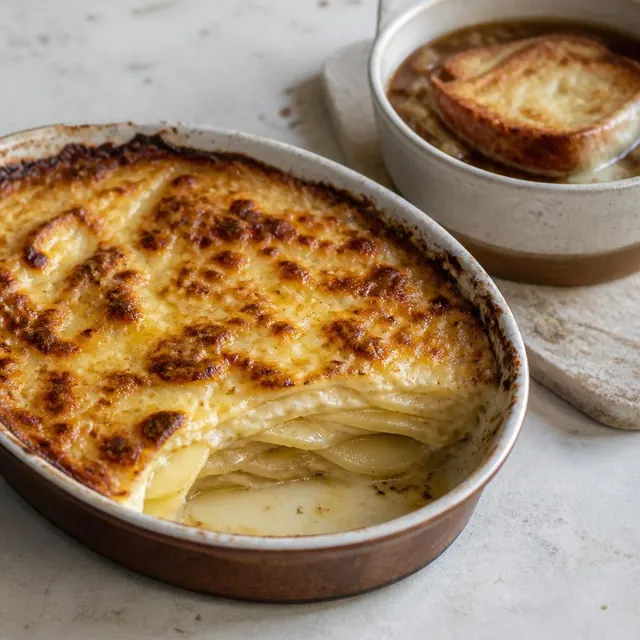
At a glance
- Origin
- French gratin from gratter, to scrape; recorded 1564, the verb gratiner 1825.
- Production
- A dish covered with sauce, breadcrumbs or cheese is baked until the surface turns golden.
- Use
- TLFi: quail, cauliflower, macaroni, fish or beef au gratin; gratinéed onion soup recorded from 1912.
- Pairs with
- Sauce, breadcrumbs, grated cheese and butter; Escoffier’s complete gratin is based on duxelles sauce.
- Substitutes
- Escoffier classes glazing as a rapid gratin.
According to the Trésor de la langue française, gratin derives from gratter, to scrape. In 1564 it meant the part of a porridge or other dish that sticks to the bottom and sides of the pot and is scraped off; from 1811 it is recorded as a way of preparing dishes. Cooking “au gratin” means putting food covered with sauce, breadcrumbs or grated cheese into the oven so that the surface browns. The verb gratiner is recorded in 1825 in Brillat-Savarin.
Escoffier’s 1907 guide distinguishes four kinds: the complete, rapid and light gratin, and glazing as a form of rapid gratin. In a complete gratin the main item finishes cooking just as the sauce reduces and the crust forms; the crust results from combining the sauce with raspings and butter under direct heat. The amount of sauce and the heat must therefore suit the size of the piece.