Kitchen terms · French cuisine
Julienne
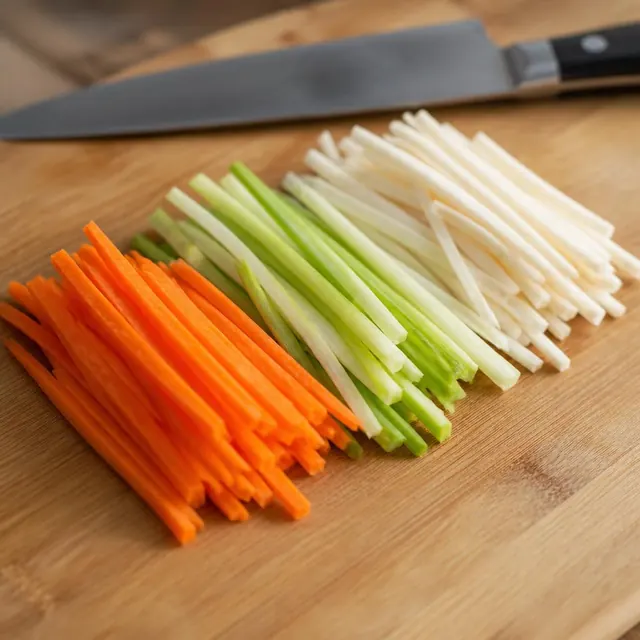
Cutting vegetables and other ingredients into thin, match-like sticks; also a soup made with vegetables cut this way.
At a glance
- Origin
- France; Larousse derives the name from the first name Julien.
- Production
- The ingredient is cut into slices and these into thin sticks of equal length.
- Ratio
- CIA: julienne 1/8 × 1/8 × 1–2 in (about 3 × 3 mm × 2.5–5 cm), fine julienne 1/16 × 1/16 × 1–2 in (about 1.5 × 1.5 mm × 2.5–5 cm); USU Extension: julienne 1/8 × 1/8 × 2½ in (about 3 × 3 mm × 6 cm).
- Use
- Vegetable garnishes for clear soups and decoration; per Larousse also julienne soup.
Julienne is the French way of cutting food into thin sticks of equal length. In the glossary of the 1907 English edition of his guide, Escoffier explains that cutting “julienne-fashion” means cutting a product into match-shaped rods. Besides this meaning, the Larousse dictionary lists a soup cooked and served with vegetables cut in this way; Escoffier counts consommé Julienne among the clear soups.
Larousse derives the word from the first name Julien, but does not explain why the cut is so called. Exact dimensions vary between schools. A chart from the Culinary Institute of America gives julienne a cross-section of 1/8 × 1/8 inch (about 3 × 3 mm) and a length of 1–2 inches (about 2.5–5 cm), and the thinner “fine julienne” 1/16 × 1/16 inch (about 1.5 × 1.5 mm) at the same length. A Utah State University Extension handout gives julienne as 1/8 × 1/8 × 2½ inches (about 3 × 3 mm × 6 cm).
Related entries
Sources
- Larousse: Dictionnaire de français – julienne
- A. Escoffier: A Guide to Modern Cookery (London 1907), Glossary – Cut, Julienne-fashion; Project Gutenberg eBook #71395
- The Culinary Institute of America (CIA Foodies): Knife Cuts Guide (2021)
- Utah State University Extension (Create Better Health): Knife Skills handout