Kitchen terms · French cuisine
Mise en place
Preparing ingredients, basic preparations and equipment before cooking begins – a core working principle of professional kitchens.
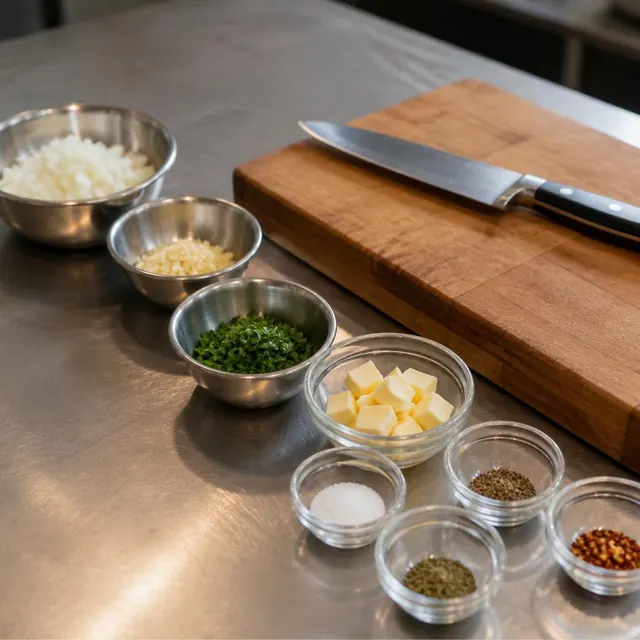
At a glance
- Origin
- French: mise (from mettre, to put) + en place, in place.
- Production
- Ingredients, bases and tools cleaned, cut, measured and set out in advance.
- Use
- Smooth work during cooking; the Cambridge Dictionary stresses the restaurant kitchen.
- Substitutes
- Escoffier uses it for the basic preparations themselves; modern dictionaries rather for the whole advance preparation.
The French phrase “mise en place” literally means “putting in place”; the noun mise derives from the participle of the verb mettre, to put or place. In the kitchen it covers everything a cook gets ready before the actual cooking starts: cleaned and cut ingredients, measured components, prepared bases and utensils.
In the glossary of the 1907 English edition of his guide, Escoffier explains mise-en-place as the general name for the elementary preparations a cook resorts to constantly during most culinary operations. The Cambridge Dictionary describes it as preparing the food and equipment needed before cooking, especially in a restaurant kitchen. The term thus refers both to the prepared items themselves and to the working routine that produces them.