Cheese and charcuterie · Italian cuisine
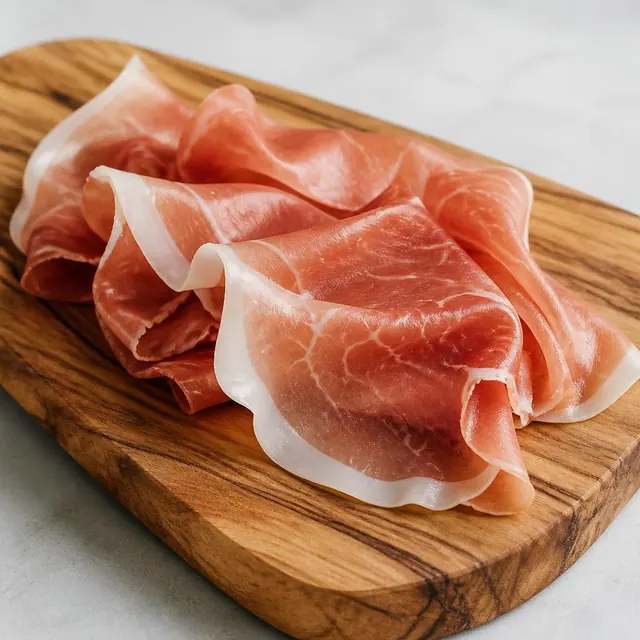
Prosciutto di Parma
Dry-cured pork leg from the hills of Parma, salted only with sea salt and aged for at least 14 months.
At a glance
- Origin
- Defined hill area in the province of Parma; PDO.
- Cut
- Pork leg.
- Ageing
- Salted only with sea salt, rested and dried; aged for at least 14 months.
- Use
- Thin raw slices as an antipasto; saltimbocca.
- Substitutes
- Another dry-cured raw ham; saltiness and aroma differ.
Prosciutto di Parma is a PDO dry-cured ham. It is cured in a defined part of the province of Parma – at least 5 km south of the Via Emilia, up to 900 m altitude, between the Enza and Stirone rivers. The legs come from pigs born, raised and slaughtered in eleven Italian regions.
The legs are salted only with sea salt; no other additives or preservatives are used. After two salting phases they rest for 60–90 days in the cold, then are washed, dried and hung in ventilated rooms; the exposed meat is coated with sugna, a paste of minced lard and salt. From the seventh month they age in cellars. Inspectors judge the aroma with a horse-bone needle. After at least 14 months and an inspection the ducal crown is fire-branded on; the finished ham weighs 8.2–12.5 kg.
It is sliced thinly and eaten raw; it also suits saltimbocca.