Cheese and charcuterie · Italian cuisine
Parmigiano Reggiano
Hard raw-milk cheese from hay-fed cows, made without additives and aged for at least twelve months.
At a glance
- Origin
- Parma, Reggio Emilia, Modena and parts of the provinces of Bologna and Mantua; PDO.
- Milk
- Raw cow’s milk, partly skimmed, from cows fed without silage.
- Ageing
- At least 12 months, on average around 24 months, often longer.
- Use
- Grated over pasta and into pesto, lasagne and risotto; older cheeses also on their own.
- Substitutes
- At a pinch Grana Padano, which matures for a shorter time; in classic recipes the swap changes the dish.
Parmigiano Reggiano is a hard cheese with Protected Designation of Origin (PDO) status from the provinces of Parma, Reggio Emilia and Modena, plus Bologna west of the Reno and Mantua south of the Po. It is made only from milk, salt and calf rennet: the milk may not be heat-treated and additives are banned. The cows eat hay and fresh forage; silage is excluded.
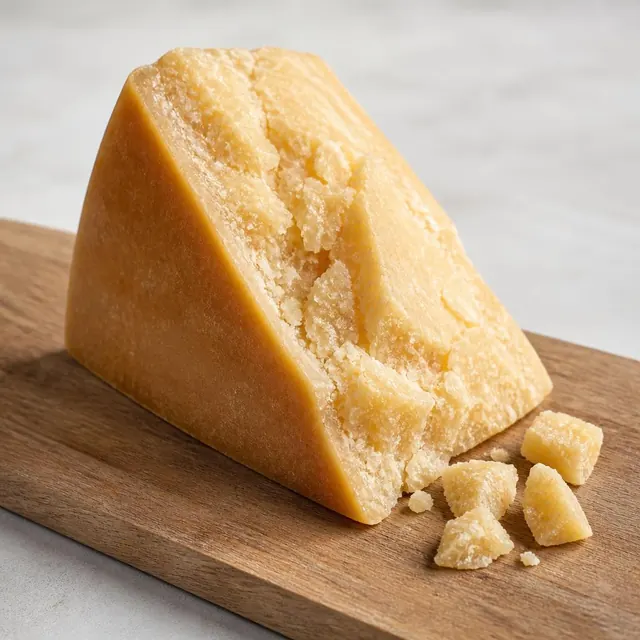
The milk is curdled in bell-shaped copper vats, the curd is cooked and moulded into wheels of at least 30 kg. The minimum maturation is 12 months, the average around 24; the age appears on the label, optionally with descriptors from delicato (12–19 months) to intenso (35–45 months). The paste is fine-grained and flaky, fragrant and full but not sharp.
It differs from Grana Padano in its silage-free feed, the ban on lysozyme and its longer minimum ageing. It is grated over pasta and into pesto, lasagne and risotto.
Recipes
Menus
Techniques and tips
Related entries
Sources
- Consorzio del Formaggio Parmigiano Reggiano: Product specification of the PDO Parmigiano Reggiano (2025)
- Consorzio del Formaggio Parmigiano Reggiano: Parmigiano Reggiano and Grana Padano (product guide)
- Consorzio Tutela Grana Padano: Grana Padano and Parmigiano Reggiano – particular aspects and specifications