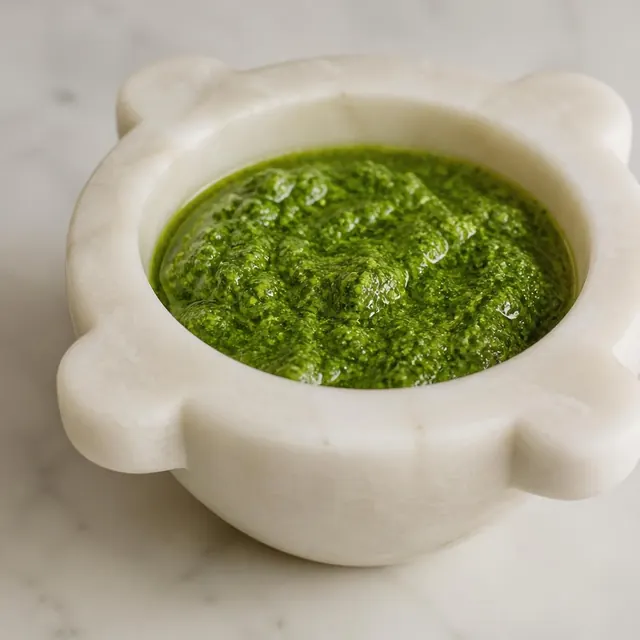
Genoese pesto (pesto alla genovese)
Genoese pesto pounded in a mortar from young basil, garlic, pine nuts and coarse salt, with Parmigiano Reggiano, Pecorino Fiore Sardo and extra virgin olive oil; never heated. Following the recipe of the Consorzio del Pesto Genovese; enough for 600 g of pasta, traditionally trofie or trenette, 6 servings.
Total time: 20 min6 servingsFinal yield 220 g
Ingredients
- 50 gBasil, fresh
- 100 mlOil, olive, salad or cooking
- 45 gCheese, parmesan, grated
- 15 gCheese, romano
- 8 gGarlic, raw
- 15 gNuts, pine nuts, dried
- 2 gSalt, table
Allergens
Contains: Milk
Derived from ingredients – check the package label.
Method
- Rinse the basil leaves quickly in cold water and dry them thoroughly on a cloth without crushing them. Grate the cheeses.
- In a marble mortar, crush the garlic with a few grains of coarse salt to a paste with a wooden pestle, then add the pine nuts and crush them too.
- Add the basil a handful at a time with the remaining grains of salt and grind it with a circular motion of the pestle against the sides of the mortar, rather than pounding, until bright green liquid runs from the leaves. Work quickly and at room temperature so the basil does not oxidise.
- Work in the Parmigiano and pecorino and finally beat in the oil drop by drop with the pestle until a smooth sauce forms. Without a mortar, you can make pesto in a blender with a chilled jar, using short pulses at low speed so it does not warm up.
- Do not heat the pesto; to serve, loosen it only with 1–2 tablespoons of pasta cooking water and toss it with the pasta off the heat. Traditionally trofie or trenette are cooked together with diced potatoes and green beans in the same water. One serving of pesto goes with one serving of pasta (about 80–100 g dried).
Recipe tradition
Not yet verified
This recipe has not been checked against a documented culinary reference.
Food data sources
- USDA FoodData Central SR Legacy (2018-04) · USDA Agricultural Research Service, FoodData Central SR Legacy. · CC0 1.0 Universal
Nutrition
Calculated from the selected ingredients; not a laboratory measurement.
Whole recipe
- Energy
- 1,178.5 kcal
- Protein
- 21.7 g
- Fat
- 118.5 g
- Total carbohydrate (by difference)
- 12.7 g
- Total dietary fibre (USDA)
- 1.5 g
- Saturated fatty acids
- 22.9 g
- Sodium
- 1,807.4 mg
- Salt (sodium × 2.5)
- 4.5 g
Per serving
- Protein3.6 g7%
- Fat19.7 g89%
- Total carbohydrate (by difference)2.1 g4%
Share of energy from protein, fat and carbohydrate (4 / 9 / 4 kcal per g), not share by weight.
- Energy
- 196.4 kcal
- Protein
- 3.6 g
- Fat
- 19.7 g
- Total carbohydrate (by difference)
- 2.1 g
- Total dietary fibre (USDA)
- 0.25 g
- Saturated fatty acids
- 3.8 g
- Sodium
- 301.2 mg
- Salt (sodium × 2.5)
- 0.75 g
Per 100 g of finished food
- Energy
- 535.7 kcal
- Protein
- 9.9 g
- Fat
- 53.9 g
- Total carbohydrate (by difference)
- 5.8 g
- Total dietary fibre (USDA)
- 0.69 g
- Saturated fatty acids
- 10.4 g
- Sodium
- 821.5 mg
- Salt (sodium × 2.5)
- 2.1 g
Salt is calculated from sodium (g salt = mg sodium × 2.5 / 1000) and includes sodium from all ingredients.
A dash means the value is unknown, not zero.
Calculation limitations
- Nutrition is a calculated estimate, not a laboratory measurement.
- The final yield is an editorial estimate.
- Some ingredient quantities use documented estimates or household-measure assumptions.
- The number of servings is an editorial estimate (midpoint of the source range or based on the dish type and energy).
- Some specific ingredients are represented by the closest generic food with the same culinary function.
- Fibre, saturated fat and sodium of cooked ingredients are estimated from the consumed ingredient amounts; for drained ingredients, sodium is included only where the retained amount is an explicit editorial estimate.
- Some process effects could not be resolved in this calculation.