Flours and grains · Italian cuisine
Carnaroli rice
Italian rice with a long, slightly tapered grain and a firm core, regarded as one of the best for risotto.
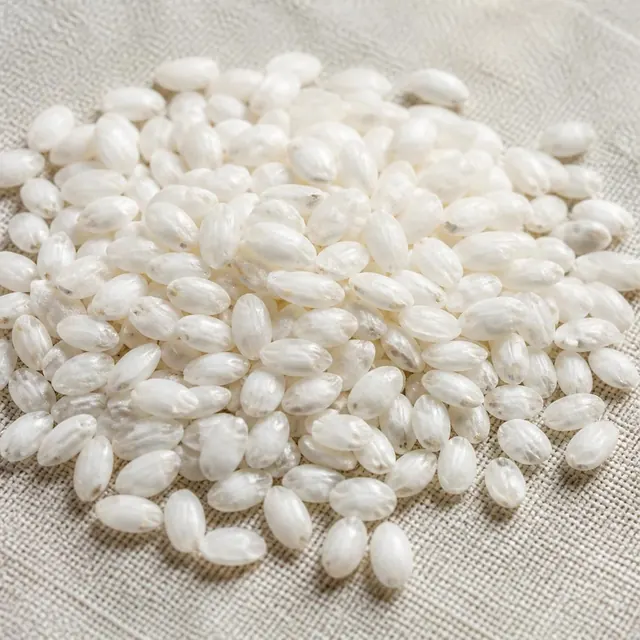
At a glance
- Origin
- Paullo (Lombardy), a 1945 cross of Vialone × Lencino; traditional trade name under Legislative Decree 131/2017.
- Ratio
- Grain 6.5–7.0 × 2.9–3.1 mm, length-to-width ratio 2.2–2.3, very extensive pearl; dimensions fall within the lungo A group (Decree 131/2017, Annex 1).
- Use
- Risotto, rice salads, timballi.
- Substitutes
- Vialone Nano, Arborio.
Carnaroli was bred in 1945 by crossing the varieties Vialone and Lencino on the Cascina Casello estate in Paullo, under the direction of Ettore De Vecchi. The origin of the name is uncertain: one version credits a water carrier who worked for De Vecchi, another a tribute to Emiliano Carnaroli, then president of the Ente Nazionale Risi.
The grain is long and semi-tapered, with a white pericarp and a centro-lateral pearl. It stays firm and al dente during cooking, which is why it is considered the ideal risotto rice; it also works in rice salads and timballi. Italy's Legislative Decree 131/2017 gives it a length of 6.5–7.0 mm, a width of 2.9–3.1 mm and a very extensive pearl.
Under current rules, similar varieties with the same grain parameters may also be sold as “Carnaroli”. The word “classico” is reserved for rice from the Carnaroli variety with proven traceability. The plant is late, tall and low-yielding, so many growers have given it up.