Flours and grains · International
Parboiled rice
Rice that is soaked, steamed and dried while still in its husk and only then milled; it cooks up separate and does not turn mushy.
At a glance
- Origin
- A traditional treatment of rough rice, alongside modern hot-water and pressure methods.
- Production
- Rough rice is soaked, steamed at 100 °C, dried and only then milled.
- Use
- Fluffy side dishes and rice salads.
- Substitutes
- White long-grain rice (less resistant to overcooking).
Parboiled rice is neither precooked nor instant rice. The treatment is applied to rough rice: traditionally it is soaked overnight or longer in water at ambient temperature, then boiled or steamed at 100 °C to gelatinise the starch, and finally cooled and dried. Only then is it stored or milled. Modern methods use a hot-water soak at about 60 °C for a few hours.
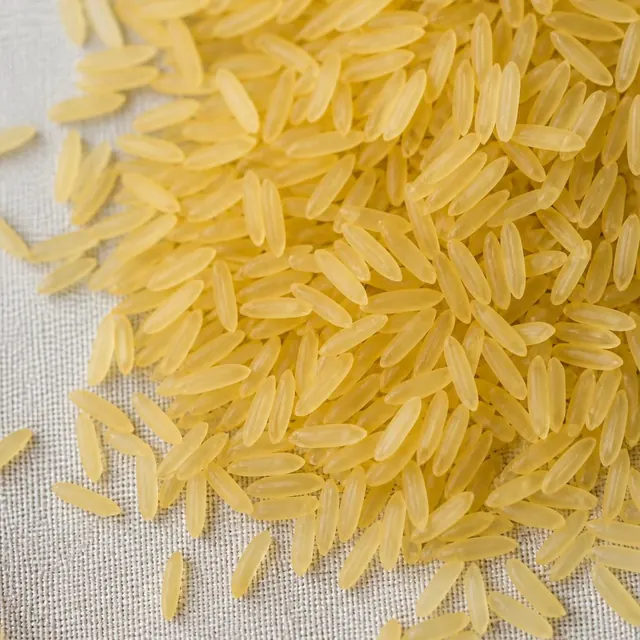
Gelatinisation hardens the endosperm and makes it translucent; even chalky grains become translucent. The rice turns cream to yellowish. Water-soluble B vitamins move from the outer layers into the grain, so milled parboiled rice contains more of them than ordinary milled rice.
It takes longer to cook than raw rice; presoaking shortens the cooking time. The cooked grains are less sticky, do not clump and resist breaking up.
Techniques and tips
Related entries
Sources
- FAO/IRRI, B. O. Juliano: Rice in human nutrition, kap. 5 Post-harvest processing, parboiling (1993)
- FAO/IRRI, B. O. Juliano: Rice in human nutrition, kap. 5 Home preparation and cooking (1993)
- FAO/IRRI, B. O. Juliano: Rice in human nutrition, kap. 6 Major processed rice products (1993)
- Altroconsumo: Riso – come scegliere le varietà in base all'uso