Flours and grains · International
Brown rice
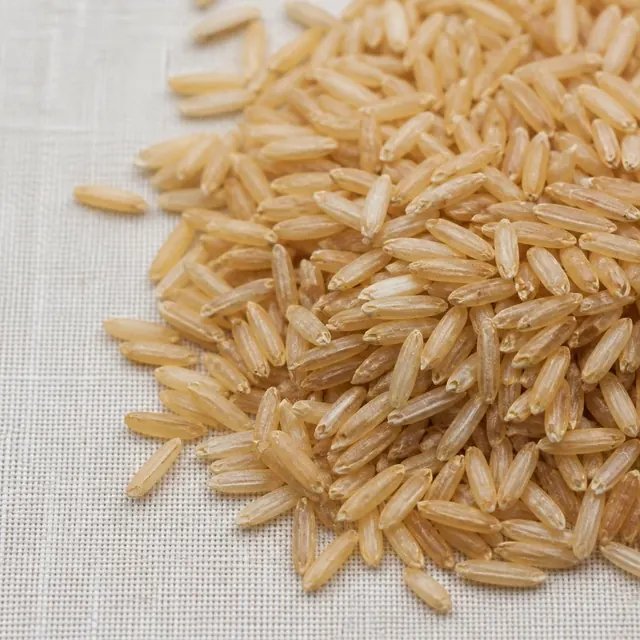
Whole-grain or brown rice with only the husk removed, keeping its bran layers and germ.
At a glance
- Origin
- A general way of processing rice; “husked rice” in EU Regulation 1308/2013, “rýže pololoupaná nebo rýže natural” in Czech Decree 18/2020.
- Production
- Only the husk is removed from paddy rice; pericarp and germ remain.
- Ratio
- Round grain up to 5.2 mm, medium grain 5.2–6.0 mm, long grain over 6.0 mm (Regulation 1308/2013).
- Substitutes
- White rice of the same grain length (without bran and germ).
Brown rice, also called whole-grain rice, is “husked rice” under EU Regulation 1308/2013 – paddy rice from which only the husk has been removed; Czech Decree 18/2020 calls it “rýže pololoupaná nebo rýže natural” and reserves “rýže loupaná” for white rice. The husk makes up about a fifth of the weight of paddy rice. The grain keeps its pericarp, seed coat and germ, which are removed in white, wholly milled rice; so the grain keeps the characteristic colour of its pericarp.
The outer pericarp is poorly permeable to water; parboiled brown rice can be made quick-cooking by scouring off about 1 % of its weight. Without the protective husk the grain is more sensitive to its environment and fissures easily.
Brown rice can come in any grain size. The same regulation distinguishes round-grain rice (up to 5.2 mm, length-to-width ratio below 2), medium-grain rice (5.2–6.0 mm, ratio no greater than 3) and long-grain rice A or B (over 6.0 mm, ratio 2–3 or 3 and above).
Techniques and tips
Related entries
Sources
- Česká republika: Vyhláška č. 18/2020 Sb. o požadavcích na mlýnské obilné výrobky, těstoviny, pekařské výrobky a cukrářské výrobky a těsta (2020)
- Evropská unie: Nařízení (EU) č. 1308/2013, příloha II část I – definice pro odvětví rýže (2013)
- FAO/IRRI, B. O. Juliano: Rice in human nutrition, kap. 3 Grain structure, composition and consumers' criteria for quality (1993)
- FAO/IRRI, B. O. Juliano: Rice in human nutrition, kap. 5 Post-harvest processing, parboiling (1993)
- FAO/IRRI, B. O. Juliano: Rice in human nutrition, kap. 6 Major processed rice products (1993)
- Ministerio de Agricultura, Pesca y Alimentación: Expediente de la Denominación de Origen Calasparra (pliego de condiciones)