Meat cuts · Czech cuisine
Pork hock (shank)
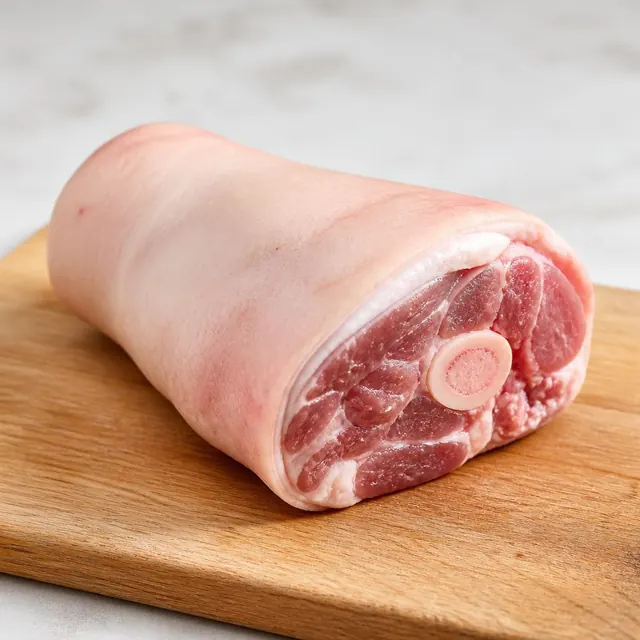
The front and hind hock of the pork side, on the bone with rind – for roasting, boiling, smoking and brawn.
At a glance
- Cut
- Lower leg above the trotter: front hock below the shoulder, hind hock below the leg.
- Production
- Sold whole on the bone with rind, front and hind.
- Use
- Roasting, boiling, smoking, brawn and aspic.
- Substitutes
- Trotters for brawn, shoulder for roasting.
Where on the animal
Pork
- Fore hock
- Hind hock
An approximate diagram; butchers divide the carcass in slightly different ways from country to country.
The hock (koleno) is the lower part of the leg above the trotter. The front hock is separated from the shoulder at the elbow, between the upper arm bone and the forearm; the hind hock follows on from the leg. Both are sold whole, on the bone with the rind.
Hock with rind is rich in collagen. How it is used changes with the season: in winter hocks are boiled for brawn and aspic, in summer they are roasted, boiled or smoked.
German names reveal regional habits: in northern Germany the hock is cured and slowly boiled as Eisbein, the Bavarian Schweinshaxe is roasted or grilled until crisp, and in Austria the hind Stelze is likewise roasted until crisp. Pork hock has nothing to do with ossobuco, which is classically made from slices of veal shank on the bone.
Techniques and tips
Related entries
Sources
- Sdružení českých spotřebitelů a Česká technologická platforma pro potraviny: Jak poznáme kvalitu? Hovězí a vepřové maso (2012)
- USDA AMS: Institutional Meat Purchase Specifications – Fresh Pork, Series 400 (2014)
- AHDB: Meat Purchasing Guide (2019)
- top agrar: Schweinefleisch – alle Teilstücke nutzen (2023)
- ichkoche.at: Was muss ich beim Schweinefleischeinkauf beachten?