Meat cuts · Czech cuisine
Beef shin (UK) / shank (US)
Sinewy muscle from the lower legs of beef, below the shoulder and the round – the classic goulash cut.
At a glance
- Cut
- Lower legs: fore shin below the shoulder in the forequarter, hind shin below the round in the hindquarter.
- Production
- Fore shin with husička and hind shin with the heel, boneless; hind shin on the bone as koleno.
- Use
- Goulash, braising, slow roasting, boiling and stock.
- Cooking time
- Braising or boiling roughly 1.5–2.5 hours depending on the size of the piece, sometimes longer.
- Substitutes
- Beef cheeks or shoulder.
Where on the animal
Beef
- Fore shin
- Hind shin
An approximate diagram; butchers divide the carcass in slightly different ways from country to country.
Shin is the muscle of the lower legs. The fore shin, sold with husička, lies in the forequarter below the shoulder and is removed by a cut through the upper arm bone. The hind shin lies in the hindquarter below the round; it is separated at the stifle joint, with the heel lying between it and the silverside.
These muscles work hard, which makes shin very sinewy. Long braising makes it tender and draws out plenty of dark, aromatic juice, especially from well-aged meat. It is a classic goulash cut, and also suits slow roasting and stock. Hind shin is leaner than fore shin.
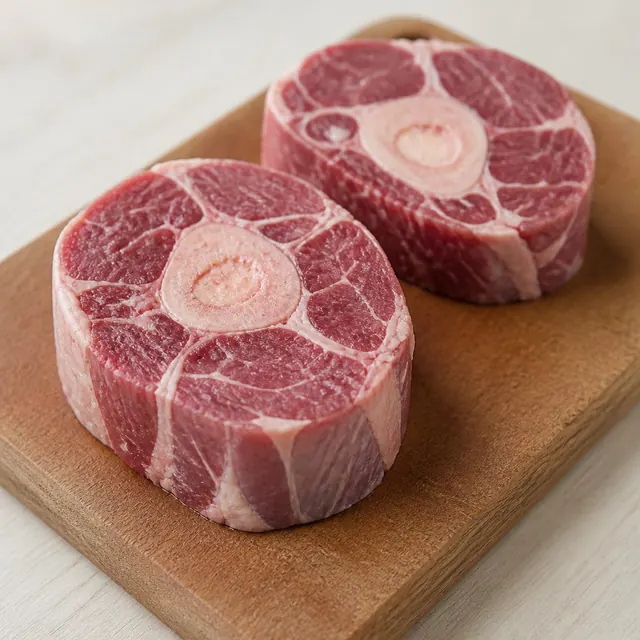
Hind shin left on the shin bone is called koleno in Czech; cut across the bone it resembles ossobuco, which is classically made from veal. In German shin is Wade or Hesse and the bone-in slices are Beinscheiben; in Austria Wadschinken is the goulash cut.
Recipes
Menus
Techniques and tips
Related entries
Sources
- Sdružení českých spotřebitelů a Česká technologická platforma pro potraviny: Jak poznáme kvalitu? Hovězí a vepřové maso (2012)
- USDA AMS: Institutional Meat Purchase Specifications – Fresh Beef, Series 100 (2014)
- AHDB: Meat Purchasing Guide (2019)
- Bayerische Landesanstalt für Landwirtschaft: Fortbildung der Ernährungsfachfrauen zum Thema Rindfleisch (2006)
- ichkoche.at: Gustostücke vom Rind
- AT Verlag: Leseprobe eines Kochbuchs über Second Cuts von Rind, Kalb und Schwein, mit Bezeichnungen für Deutschland, Schweiz und Österreich (2018, ISBN 978-3-03800-082-2)