Meat cuts · Czech cuisine
Beef round (US) / topside and silverside (UK)
The hind leg of beef, split into lean muscles – the usual cut for svíčková, beef roulades and steak tartare.
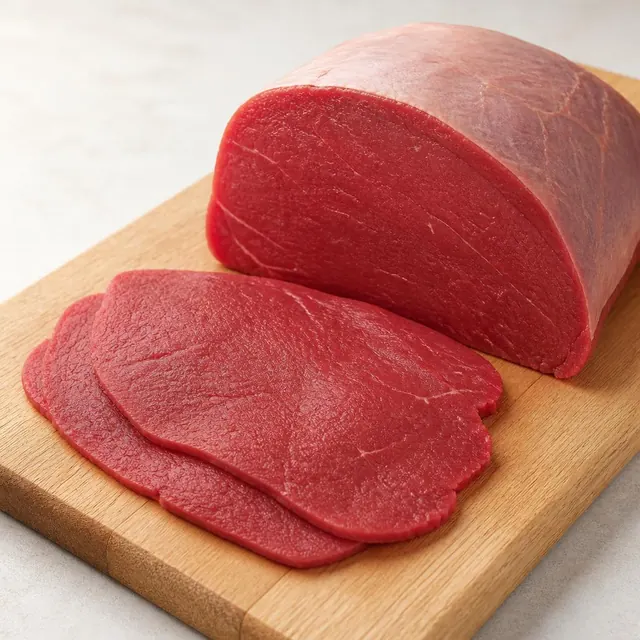
At a glance
- Cut
- Hindquarter: the hind leg between the loin and the hind shank, around the thigh bone.
- Production
- Sold boneless and separated along the seams into topside, silverside, thick flank, rump and váleček; the heel is taken off the silverside.
- Use
- Braised or roasted whole or in slices – svíčková, Spanish birds; topside also for steak tartare.
- Cooking time
- Braising roughly 1.5–2.5 hours depending on the size of the piece, sometimes longer.
- Substitutes
- For svíčková the round shoulder cut called false tenderloin.
Where on the animal
Beef
- Round (leg)
An approximate diagram; butchers divide the carcass in slightly different ways from country to country.
The round is the hind leg of the carcass, in the hindquarter. It joins the loin at the top and runs down through the heel to the hind shank, with the thigh bone inside. Czech butchers bone it and split it along the seams into its main muscles, the šály: vrchní šál (topside), spodní šál (silverside), velký ořech (thick flank), květová špička (rump) and the long, round váleček.
The round is lean, but its parts differ. Topside is used for anything from steak tartare to slices. Silverside has coarser fibres and more connective tissue, so it goes mainly into Spanish birds (beef roulades) and roasts; its triangular top part is the tabulová špička (rump cap, picanha, Tafelspitz). The outer thick flank works hardest and suits only roasting and braising.
Svíčková na smetaně is named after the tenderloin, but it is often made from the váleček or from a shoulder cut called false tenderloin.
Recipes
Menus
Techniques and tips
Related entries
Sources
- Sdružení českých spotřebitelů a Česká technologická platforma pro potraviny: Jak poznáme kvalitu? Hovězí a vepřové maso (2012)
- AHDB: Meat Purchasing Guide (2019)
- USDA AMS: Institutional Meat Purchase Specifications – Fresh Beef, Series 100 (2014)
- Bayerische Landesanstalt für Landwirtschaft: Fortbildung der Ernährungsfachfrauen zum Thema Rindfleisch (2006)
- AT Verlag: Leseprobe eines Kochbuchs über Second Cuts von Rind, Kalb und Schwein, mit Bezeichnungen für Deutschland, Schweiz und Österreich (2018, ISBN 978-3-03800-082-2)