Meat cuts
Meat aging
Controlled cold storage of meat in which the muscle's own enzymes make it more tender and change its flavour.
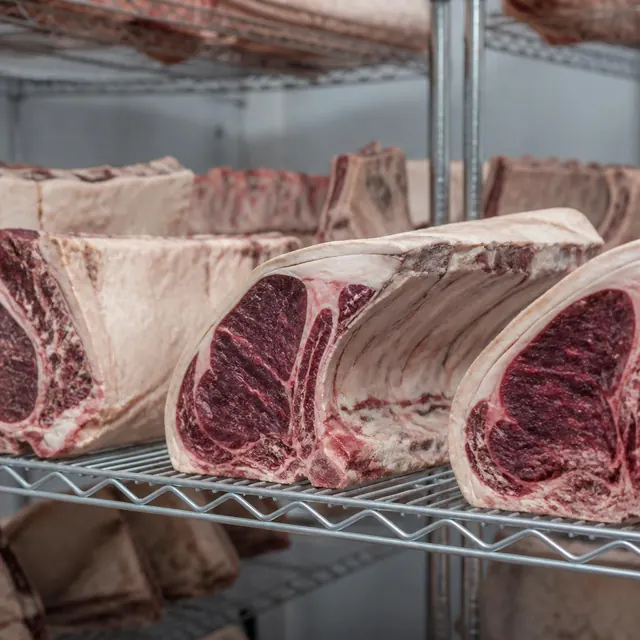
At a glance
- Production
- After slaughter the meat is kept cold either unpackaged (dry aging) or vacuum packed (wet aging) and is tenderised by its own enzymes.
- Ageing
- Ordinary beef is sold 7–21 days after slaughter; dry aging usually lasts 14–40 days or longer.
- Use
- Mainly high-quality beef from the back – rib, short loin with T-bone and rump.
- Ratio
- Most enzyme activity occurs within 7 days, the largest gain in tenderness within 14 days.
Aging is the controlled cold storage of meat after slaughter, during which it becomes more tender and its flavour changes. The muscle's own enzymes, mainly the calcium-dependent calpains, gradually break down protein structures in the muscle fibres.
According to a 2016 scientific review of beef aging, most enzyme activity takes place in the first week and the largest gain in tenderness occurs within 14 days, after which improvement slows. Cathepsins and other processes contribute to the formation of flavour peptides.
Beef is aged by two main methods: dry aging of unpackaged meat in a cooler with controlled humidity and air flow, and wet aging in vacuum packaging. Beef sold in shops is commonly wet aged or vacuum packed 7–21 days after slaughter.