Meat cuts · International
Ribeye
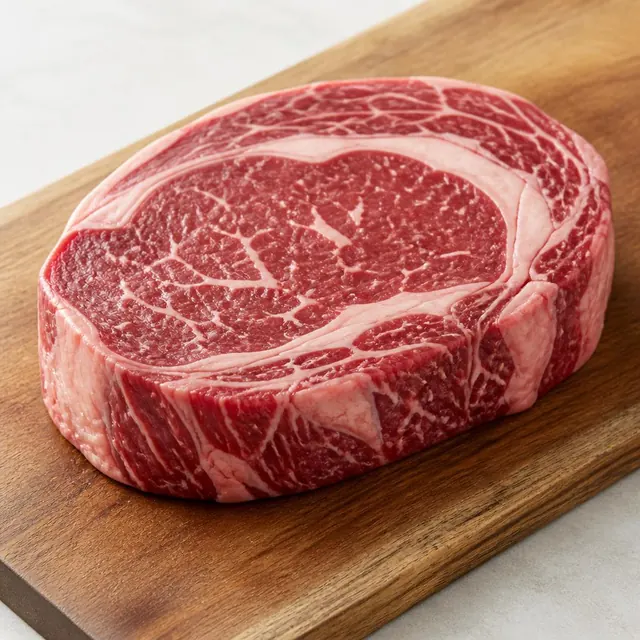
A marbled cut from the front of the back behind the shoulder – ribeye and entrecôte, bone-in côte de bœuf and tomahawk.
At a glance
- Cut
- Front of the back behind the shoulder (ribeye roughly ribs 6–12 in German and US butchery); longissimus dorsi and spinalis dorsi.
- Ageing
- Suited to bone-in dry aging, typically around 21–28 days or longer.
- Production
- Boneless as ribeye or entrecôte, bone-in as côte de bœuf or tomahawk with a long cleaned rib bone.
- Use
- Fierce grilling or pan-searing; a large bone-in piece can be roasted whole.
- Substitutes
- Striploin, which is leaner.
Where on the animal
Beef
- Rib (ribeye)
An approximate diagram; butchers divide the carcass in slightly different ways from country to country.
The rib is the front part of the back behind the shoulder blade, between the chuck and the striploin. In German and American butchery ribeye steaks come roughly from the 5th–6th to the 12th–13th rib, which does not match the Czech quartering between the 8th and 9th thoracic vertebrae; they consist mainly of the longissimus dorsi, topped by the spinalis dorsi or ribeye cap, with the small complexus muscle at the front. In the Czech grading the rib counts as second-quality meat.
Boneless it is sold as ribeye or entrecôte, on the bone as côte de bœuf. A tomahawk is a bone-in steak that keeps at least about 13 cm of cleaned rib bone. It is called scotch fillet in Australia, ojo de bife in Argentina, Rostbraten in Austria and Hohrücken in Switzerland.
The cut is prized for its marbling, especially in the cap. The bone-in rib is one of the classic cuts for dry aging.
Techniques and tips
Related entries
Sources
- Wikipedia (de): Hochrippe
- Wikipedia: Rib eye steak
- Acta Universitatis Agriculturae et Silviculturae Mendelianae Brunensis 56(5): Vliv kategorie skotu na jakostní parametry jatečně upraveného těla (2008)
- Dashdorj D., Tripathi V. K., Cho S., Kim Y., Hwang I.: Dry aging of beef; Review. Journal of Animal Science and Technology 58:20 (2016)
- Sdružení českých spotřebitelů a Česká technologická platforma pro potraviny: Jak poznáme kvalitu? Hovězí a vepřové maso (2012)
- Wikipedia (de): Fehlrippe