Meat cuts · International
T-bone and porterhouse steak
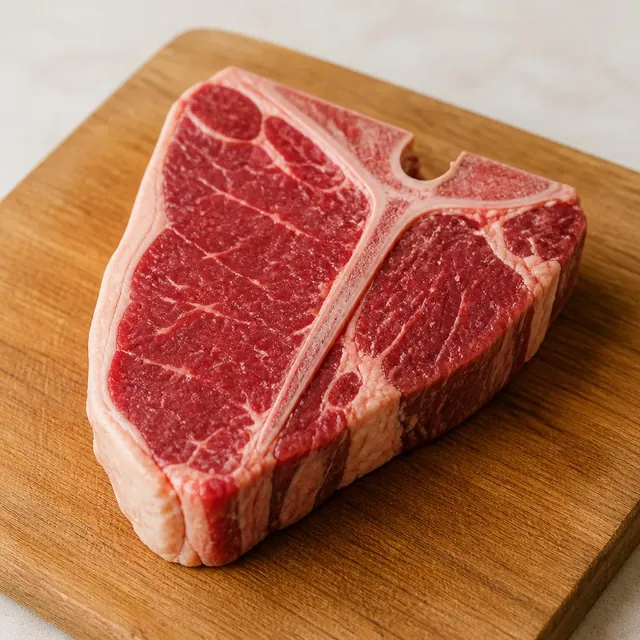
A steak on a T-shaped bone: striploin on one side, tenderloin on the other, whose width decides the name.
At a glance
- Cut
- Hindquarter, short loin in the lumbar region; striploin and tenderloin on a lumbar vertebra.
- Ageing
- A classic cut for bone-in dry aging, typically around 21–28 days.
- Production
- Cut crosswise through the vertebra; porterhouse with tenderloin at least 32 mm wide, T-bone at least 13 mm.
- Use
- Grilling or pan-searing; the fiorentina is traditionally served very rare.
- Substitutes
- A striploin steak and a tenderloin medallion separately.
Where on the animal
Beef
- Sirloin (striploin)
- Tenderloin
An approximate diagram; butchers divide the carcass in slightly different ways from country to country.
T-bone and porterhouse are cut crosswise through the short loin in the lumbar region of the hindquarter. In the middle sits a lumbar vertebra with its T-shaped transverse process, with the striploin (longissimus dorsi) on one side and the tenderloin (psoas major) on the other.
The difference lies in the size of the tenderloin. Under the US IMPS specifications the tenderloin of a porterhouse must be at least 32 mm (1.25 inches) wide at its widest point, that of a T-bone at least 13 mm (0.5 inch). Porterhouse therefore comes from the rear of the short loin, T-bone from the front.
Bistecca alla fiorentina is the Tuscan T-bone, traditionally from Chianina or Maremmana cattle, grilled over charcoal or wood, seasoned with salt, sometimes pepper and olive oil, and served very rare. Bone-in short loin steaks are classic cuts for dry aging.