Meat cuts
Dry aging
Aging unpackaged beef in a cooler: the meat loses water, concentrates its flavour and forms a crust on the surface.
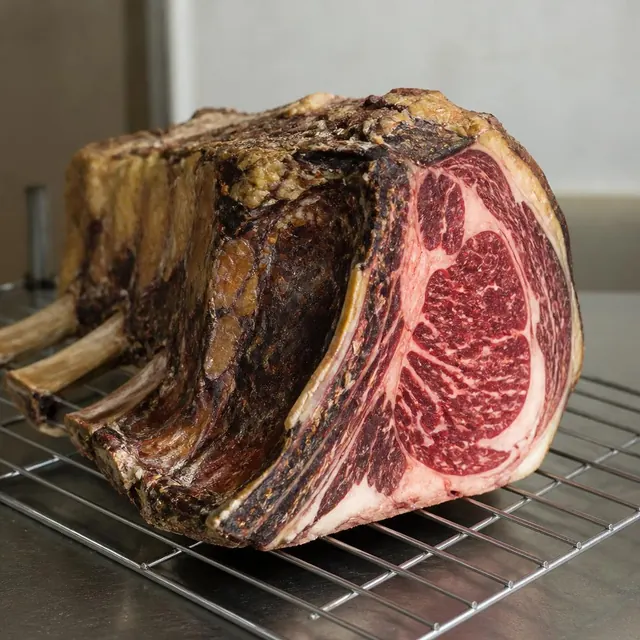
At a glance
- Production
- Unpackaged meat in a cooler at 0–4 °C, roughly 61–85 % relative humidity and about 0.5–2 m/s air flow.
- Ageing
- Usually 14–40 days, typically around 21 days; 28 days is often regarded as the minimum.
- Use
- Bone-in cuts with fat cover – rib, striploin, T-bone, porterhouse – from well-marbled beef.
- Ratio
- Evaporation loss 6–15 % and trim loss 3–24 %; about 10 % after 21 days and 15 % after 30 days.
In dry aging, carcass sides hang or unpackaged primal cuts lie in a cooler with controlled temperature, humidity and air flow. A 2016 scientific review most often cites 0–4 °C, a relative humidity of roughly 61–85 % and an air speed of about 0.5–2 m/s.
Most cuts are aged for 14–40 days, typically around 21 days; processors regard 28 days as the minimum for a marked effect, and some age beyond 100 days. The surface dries into a hard crust that is trimmed off before portioning; the desirable mould Thamnidium may grow on the fat, while Rhizopus and Mucor are unwanted. With good hygiene, up to 35 days did not harm flavour or safety; trimmed cuts keep only 2–3 days.
Evaporation usually costs 6–15 % of the weight and trimming the crust a further 3–24 %, so the meat is expensive. The flavour is described as intensely beefy, nutty and roasted, with mushroom notes after longer aging.