Meat cuts
Wet aging
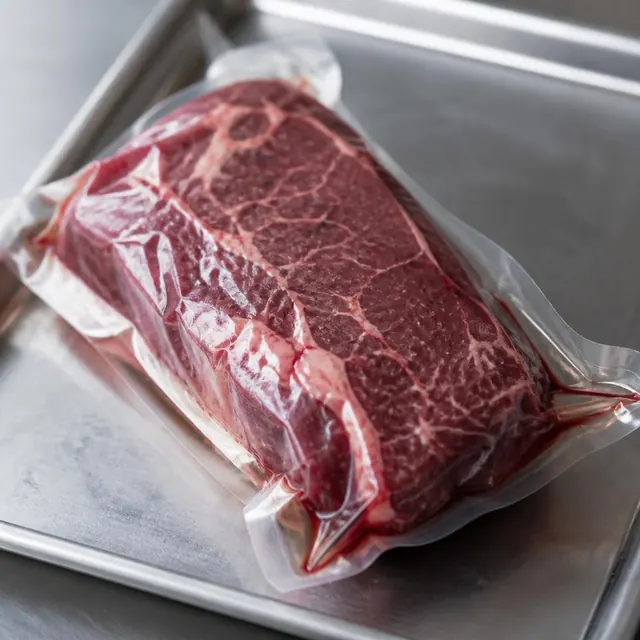
Aging beef in vacuum packaging: the meat becomes tender without drying out or forming a crust, with much higher yield.
At a glance
- Production
- Primal or retail cuts in vacuum packaging kept cold; the meat does not dry out or form a crust.
- Ageing
- Commonly 7–21 days after slaughter; premium cuts are also sold after 21–30 days.
- Use
- All steak cuts including lean and boneless ones, such as tenderloin, rump cap and rib or striploin.
- Ratio
- Saleable ribeye yield about 88 % versus roughly 64–72 % with dry aging, decreasing as dry aging lengthens from 14 to 35 days.
Wet aging takes place in vacuum packaging under refrigeration. The meat does not dry out or form a crust, but, as in dry aging, it is tenderised by the muscle's own enzymes. Beef sold in shops is commonly wet aged or vacuum packed 7–21 days after slaughter.
Its yield is much higher than that of dry aging: for ribeyes, a 2016 review reports a saleable yield of about 88 % with wet aging against roughly 64–72 % with dry aging, falling from 72 to 64 % as dry aging is extended from 14 to 35 days.
After 11 days both methods improved tenderness to a similar degree, while results for longer aging differ. Some trained panels described wet-aged beef as having more sour, metallic and bloody notes and dry-aged beef as beefier and more roasted; in other studies consumers could not tell them apart.