Meat cuts · International
Striploin (New York strip)
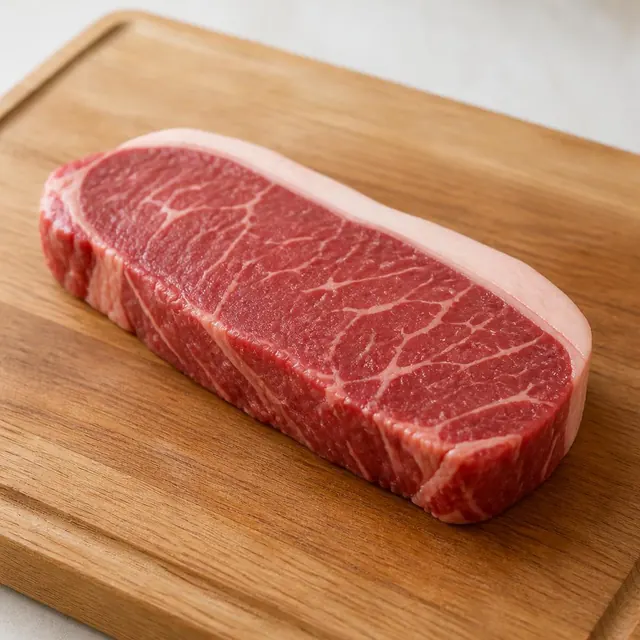
A leaner steak cut from the rear of the back with a fat edge – strip, sirloin and the German Rumpsteak.
At a glance
- Cut
- Hindquarter, rear part of the back including the lumbar region; longissimus dorsi.
- Ageing
- Suited to bone-in dry aging and to wet aging; dry aging typically around 21–28 days.
- Production
- Boneless steaks with a fat edge, or bone-in with part of the tenderloin as T-bone and porterhouse.
- Use
- Grilling and pan-searing; roasted whole as roast beef.
- Substitutes
- Ribeye (fattier) or tenderloin (more tender and leaner).
Where on the animal
Beef
- Sirloin (striploin)
An approximate diagram; butchers divide the carcass in slightly different ways from country to country.
The striploin is the rear part of the back between the rib and the leg, behind the quartering point (between the 8th and 9th thoracic vertebrae) and along the lumbar vertebrae. It consists of the longissimus dorsi, a muscle that does little work along the back; in the Czech grading it belongs, together with the tenderloin, to first-quality meat.
Boneless steaks have a fat edge along one side. In the US they are called strip or New York strip, in Britain sirloin steak and in Germany Rumpsteak; roasted whole it is roast beef. Cut on the bone together with part of the tenderloin, this section gives the T-bone and porterhouse.
Mind the names: the British rump steak is cut from the rump next to the leg, whereas the German Rumpsteak is a slice from the back. On the Czech market the word rumpsteak is used both for striploin steaks and for the rump (květová špička), so it is worth checking which part the meat comes from.
Techniques and tips
Related entries
Sources
- Wikipedia: T-bone steak (podle USDA IMPS Fresh Beef Series 100, 2014)
- Wikipedia (de): Rumpsteak
- Expats.cz: Beef cuts – české názvy hovězích řezů
- Acta Universitatis Agriculturae et Silviculturae Mendelianae Brunensis 56(5): Vliv kategorie skotu na jakostní parametry jatečně upraveného těla (2008)
- AHDB Meat Purchasing Guide: Rump Cap (picanha), kód Rump B015
- Rohlík.cz: Steinhauser hovězí květová špička (rump steak) – popis produktu
- Dashdorj D., Tripathi V. K., Cho S., Kim Y., Hwang I.: Dry aging of beef; Review. Journal of Animal Science and Technology 58:20 (2016)