Meat cuts · International
Beef tenderloin (fillet)
The most tender beef cut – a barely used muscle beneath the lumbar spine, source of filet mignon and chateaubriand.
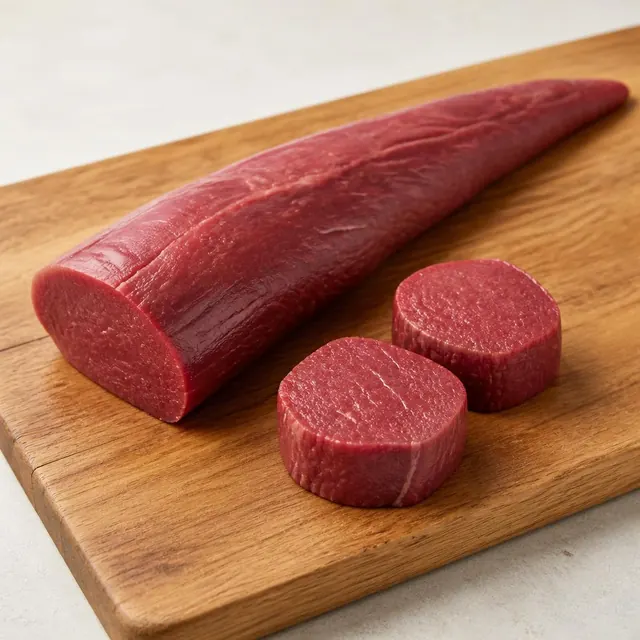
At a glance
- Cut
- Hindquarter, underside of the lumbar spine near the kidneys; psoas major muscle.
- Ageing
- Usually wet aged in vacuum packaging, like most beef on sale.
- Production
- The whole boneless muscle is trimmed of fat and membranes; steaks from the centre are cut crosswise.
- Use
- Quick searing in a pan or on a grill, or roasting whole; the butt also for carpaccio.
- Substitutes
- The closest is striploin, which is fattier and less tender.
Where on the animal
Beef
- Tenderloin
An approximate diagram; butchers divide the carcass in slightly different ways from country to country.
The tenderloin is the psoas major muscle, which lies beneath the transverse processes of the lumbar vertebrae near the kidneys and runs through the short loin and the sirloin. It does very little work in life, which makes it the most tender cut of beef; in the Czech grading it belongs to first-quality meat.
The tapering muscle is divided into the thick butt, the centre cut and the thin tail. Filet mignon and chateaubriand are cut from the centre, which is also used for beef Wellington, and tournedos, served in pairs, from the tail; the butt suits carpaccio, for example.
The meat is lean and fine-textured, so steaks are seared briefly in a pan or on a grill and larger pieces are roasted whole. The tenderloin forms the smaller part of T-bone and porterhouse steaks. It is called fillet in Britain, eye fillet in Australasia, solomillo in Spanish and Filet or Lendenbraten in German.
Techniques and tips
Related entries
Sources
- Wikipedia: Beef tenderloin
- Acta Universitatis Agriculturae et Silviculturae Mendelianae Brunensis 56(5): Vliv kategorie skotu na jakostní parametry jatečně upraveného těla (2008)
- Wikipedia: T-bone steak (podle USDA IMPS Fresh Beef Series 100, 2014)
- Dashdorj D., Tripathi V. K., Cho S., Kim Y., Hwang I.: Dry aging of beef; Review. Journal of Animal Science and Technology 58:20 (2016)