Meat cuts
Doneness
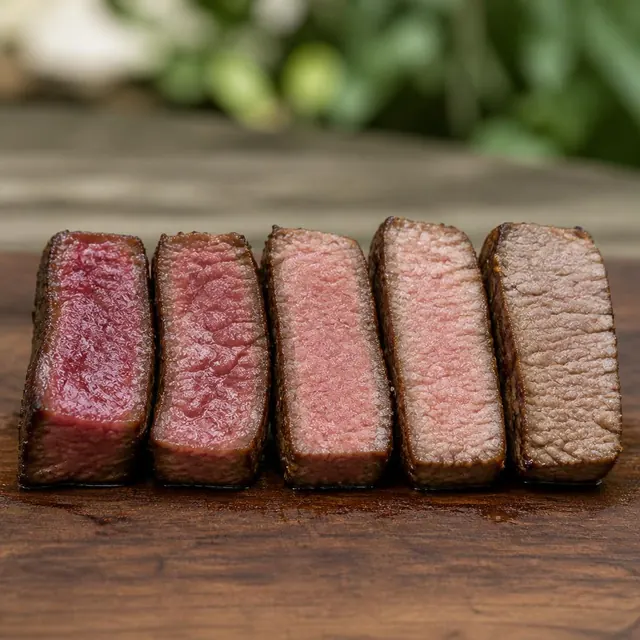
From rare to well done: the doneness of a steak is best judged by the core temperature of the meat.
At a glance
- Production
- Determined by the core temperature measured with a probe thermometer; time and appearance are only a guide.
- Use
- Take the meat off the heat a few degrees early and let it rest before slicing.
- Ratio
- Roughly rare 52–55 °C, medium rare 55–60 °C, medium 60–65 °C, medium well 65–69 °C, well done from 71 °C; USDA: whole cuts 63 °C, ground meat 71 °C.
The doneness of a steak is most reliably judged by its core temperature. The English stages rare, medium rare, medium, medium well and well done have French counterparts bleu, saignant, à point and bien cuit, although sources match them up differently.
Indicative core temperatures from a widely cited table: rare 52–55 °C, medium rare 55–60 °C, medium 60–65 °C, medium well 65–69 °C and well done from 71 °C; very rare bleu 46–49 °C. Lower serving temperatures are also given, for example 52–54 °C for medium rare.
After the meat comes off the heat its core temperature keeps rising, by roughly 3–8 °C depending on the source, so it is removed a little early and left to rest. For safety, US authorities recommend cooking whole cuts to 63 °C with a rest of at least 3 minutes, and ground meat to 71 °C.