Meat cuts
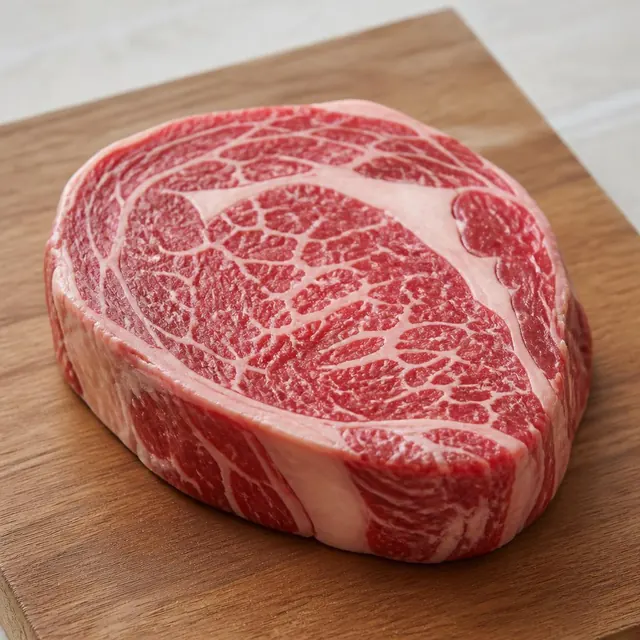
Marbling
Intramuscular fat in fine streaks, used to grade beef quality in the United States and in Japan.
At a glance
- Production
- Fat deposited between muscle fibres; assessed on the cross-section of the longissimus muscle.
- Use
- Determines the quality grade; dry aging uses beef of upper Choice and Prime grades.
- Ratio
- USDA: Prime from “slightly abundant”, Choice “small” to “moderate”, Select “slight”; the Japanese scale has 12 grades.
Marbling is the intramuscular fat that shows as fine white streaks on the cut surface of meat. It is the main criterion for grading beef quality and is assessed on the cross-section of the longissimus muscle in the rib area.
The USDA sorts beef into eight quality grades according to marbling and physiological maturity of the animal. Prime requires at least “slightly abundant” marbling, Choice “small” to “moderate” and Select “slight”; the assessment is made where the carcass is cut between the 12th and 13th ribs.
The Japanese marbling scale has 12 grades and is read between the 6th and 7th ribs, where a Canadian study found on average about a third more intramuscular fat than at the North American grading site, so grades from different systems cannot be compared directly. Dry aging is recommended for beef with at least “modest” marbling.
Related entries
Sources
- University of Nebraska–Lincoln, BeefWatch: Determining Value of Beef Through Grading (2022)
- The Cattle Site / CAB Industry Information: Beef Grades (2008)
- Beef Cattle Research Council (Kanada): Beef Beyond Borders – kanadské a japonské hodnocení mramorování
- Dashdorj D., Tripathi V. K., Cho S., Kim Y., Hwang I.: Dry aging of beef; Review. Journal of Animal Science and Technology 58:20 (2016)