Meat cuts · Czech cuisine
Beef ribs (short ribs)
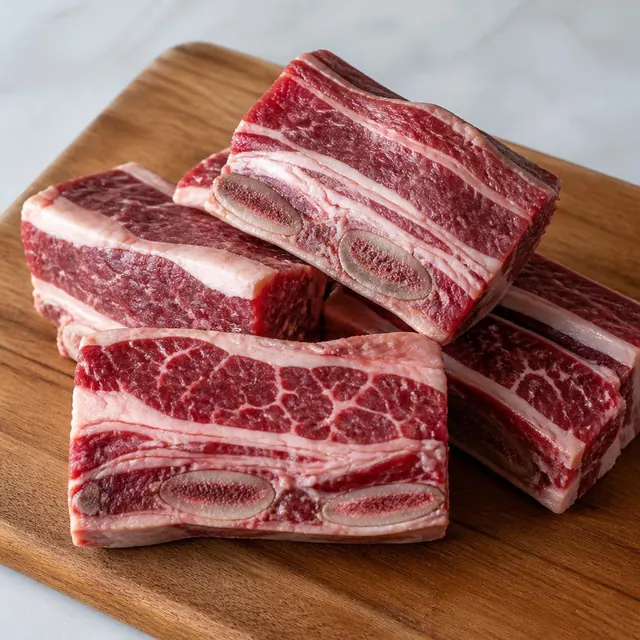
Forequarter ribs with the meat between them – well-marbled, for slow grilling, braising and rich stock.
At a glance
- Cut
- Forequarter: ribs 1 to 8 with the intercostal meat, without the brisket.
- Production
- Sold bone-in as high and bare rib, with the brisket or boneless; ribs 9 to 13 as bone-in flank.
- Use
- Slow grilling whole, braising, rolls and rich stock.
- Substitutes
- Brisket or the bone-in flank (low rib).
Where on the animal
Beef
- Ribs
An approximate diagram; butchers divide the carcass in slightly different ways from country to country.
In Czech cutting, žebro comprises the high and the bare rib of the forequarter, that is ribs 1 to 8 without the brisket, together with the intercostal meat. It is trimmed into a neat rectangle. Ribs 9 to 13 are sold separately as bone-in flank, called the low rib.
The ribs are heavily marbled and stay juicy when cooked. Whole, they can be cooked slowly for several hours in a closed grill; boned, they are used for rolls or braising, and meaty pieces are sliced thinly. They are also the base of a strong stock.
American short ribs, Jacob’s ladder in Britain, are a comparable cut, but the boundaries differ: the US specification takes them from ribs 6 to 10, and chuck short ribs from ribs 2 to 5. In German the cut is called Querrippe or Spannrippe; in Austria the meat covering the ribs is boiled as Beinfleisch.
Techniques and tips
Related entries
Sources
- Sdružení českých spotřebitelů a Česká technologická platforma pro potraviny: Jak poznáme kvalitu? Hovězí a vepřové maso (2012)
- USDA AMS: Institutional Meat Purchase Specifications – Fresh Beef, Series 100 (2014)
- AHDB: Meat Purchasing Guide (2019)
- AT Verlag: Leseprobe eines Kochbuchs über Second Cuts von Rind, Kalb und Schwein, mit Bezeichnungen für Deutschland, Schweiz und Österreich (2018, ISBN 978-3-03800-082-2)
- ichkoche.at: Gustostücke vom Rind