Meat cuts · Czech cuisine
Oxtail
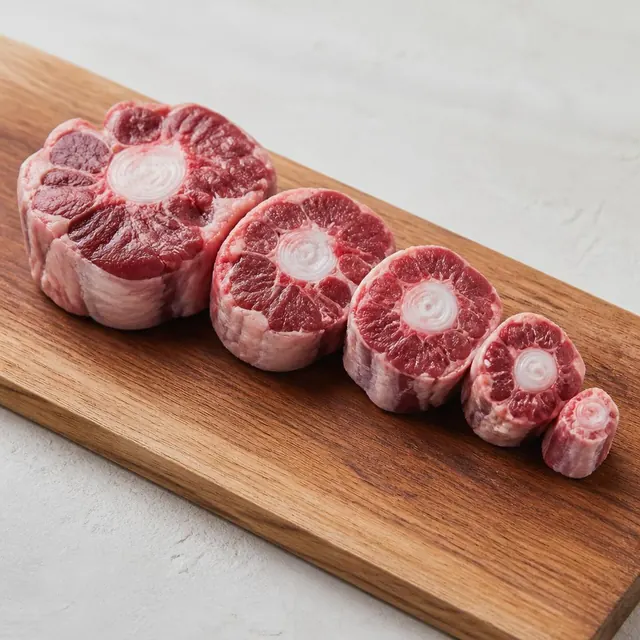
The tail of beef, on the bone and rich in gelatine – the base of very strong stocks and braised dishes.
At a glance
- Cut
- The tail of the animal, behind the sacrum.
- Production
- Sold on the bone, without the sacrum and remnants of hide.
- Use
- Strong stocks, soups and braises.
- Cooking time
- Braising about 3½ hours at 170 °C; at a low temperature (110 °C) up to around 10 hours.
- Substitutes
- Shin, or marrow bones and other soup bones for stock.
Where on the animal
Beef
- Oxtail
An approximate diagram; butchers divide the carcass in slightly different ways from country to country.
Oxtail is the tail of the animal. It is sold on the bone, trimmed without the sacrum, remnants of hide and the smooth muscle of the rectum. The meat on the tail vertebrae is compact, sinewy and high in gelatine.
Oxtail is a somewhat neglected cut that makes very strong stocks with a distinctive flavour. It also suits braising; like shin it is sinewy and needs long, moist cooking. Its high gelatine content shows in both the stock and the sauce after long cooking.
In German cooking the tail, Ochsenschwanz, is braised as well as boiled for soup. The British trade guide lists it among the offal as ox tail.
Techniques and tips
Related entries
Sources
- Sdružení českých spotřebitelů a Česká technologická platforma pro potraviny: Jak poznáme kvalitu? Hovězí a vepřové maso (2012)
- Bayerische Landesanstalt für Landwirtschaft: Fortbildung der Ernährungsfachfrauen zum Thema Rindfleisch (2006)
- AHDB: Meat Purchasing Guide (2019)
- AT Verlag: Leseprobe eines Kochbuchs über Second Cuts von Rind, Kalb und Schwein, mit Bezeichnungen für Deutschland, Schweiz und Österreich (2018, ISBN 978-3-03800-082-2)
- Simply Beef & Lamb: Braised Oxtail with Star Anise
- Great British Chefs: Braised Oxtail with Celeriac