Meat cuts · Czech cuisine
Beef cheeks (ox cheek)
The chewing muscles of beef – lean but full of connective tissue; long braising makes them silky and tender.
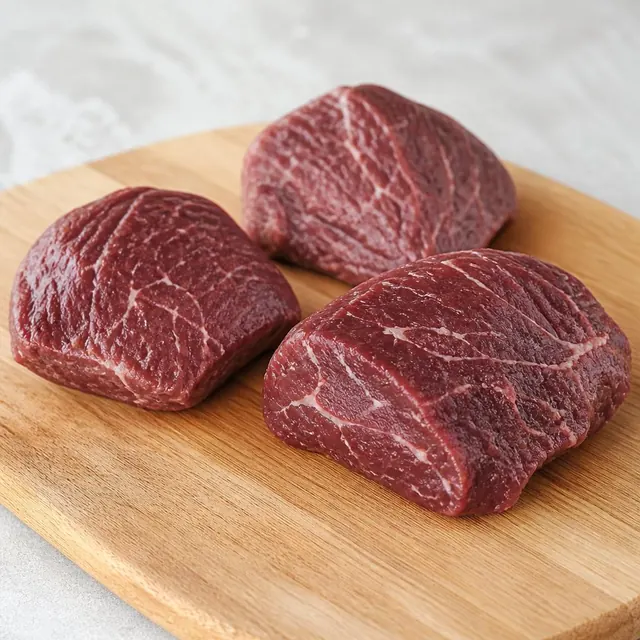
At a glance
- Cut
- Head: the chewing muscles on the outer side of the cheekbones.
- Production
- Sold on their own as boneless muscle; in the British trade they count as offal.
- Use
- Long braising, goulash.
- Substitutes
- Shin.
Where on the animal
Beef
- Head
An approximate diagram; butchers divide the carcass in slightly different ways from country to country.
Cheeks are the chewing muscles on the outer side of the cheekbones, part of the head in front of the neck. They are among the hardest-working muscles of the animal: lean, but with a high share of connective tissue. The British trade guide lists them among the offal as ox cheek.
Cheeks are therefore no cut for quick cooking but for long braising. Their fine muscle fibres and delicate collagen then give them tenderness and a mild flavour. They also suit goulash; long neglected in the Czech Republic, they are now bought mainly for braising.
In German they are called Ochsenbacke or Rinderbacke, in Austria Backerl. In Italy, pork cheek and jowl are cured into guanciale.
Techniques and tips
Related entries
Sources
- Sdružení českých spotřebitelů a Česká technologická platforma pro potraviny: Jak poznáme kvalitu? Hovězí a vepřové maso (2012)
- AHDB: Meat Purchasing Guide (2019)
- AT Verlag: Leseprobe eines Kochbuchs über Second Cuts von Rind, Kalb und Schwein, mit Bezeichnungen für Deutschland, Schweiz und Österreich (2018, ISBN 978-3-03800-082-2)