Meat cuts · Czech cuisine
Beef neck
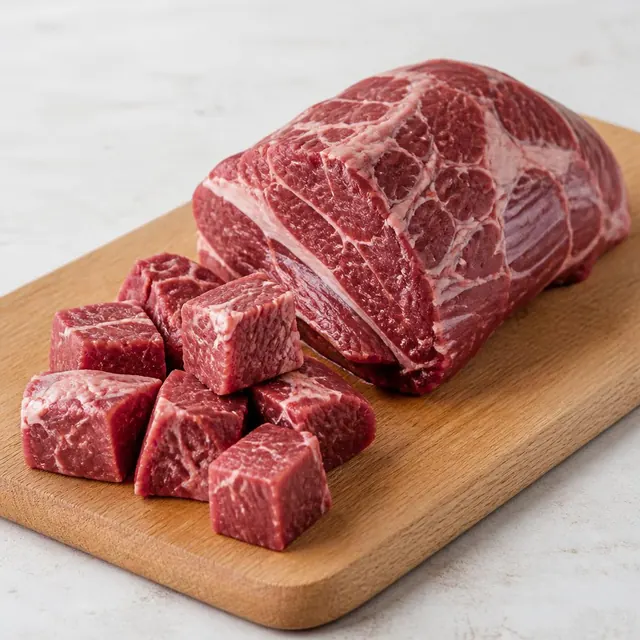
Marbled meat from the neck of beef, coarse-grained and sinewy – for braising, boiling and mincing.
At a glance
- Cut
- Forequarter: the neck between the head and podplečí, with the neck vertebrae.
- Production
- Sold boneless as neck tip and neck; vertebrae and neck ligament are removed.
- Use
- Braising, boiling and mincing.
- Cooking time
- Braising or boiling roughly 1.5–2.5 hours depending on the size of the piece, sometimes longer.
- Substitutes
- The less sinewy podplečí or the shoulder.
Where on the animal
Beef
- Neck
An approximate diagram; butchers divide the carcass in slightly different ways from country to country.
The neck is the front end of the forequarter, between the head and podplečí, through which it passes into the fore rib. It is built around the neck vertebrae, which are carefully removed in retail cutting together with the neck ligament and other coarse connective tissue. Czech butchers sell it as neck tip and boneless neck; in British and American trade terms it is neck of beef, part of the chuck.
Neck meat is lightly marbled with fat, coarse-grained and high in connective tissue. It therefore belongs to braising and boiling, and long, moist cooking makes it tender. Trimmed neck muscle is also excellent for mince.
In Germany beef neck is called Kamm, Hals or Nacken and is braised as a sinewy but inexpensive cut. In Austria the lean neck meat (Hals) is mostly minced, while the fattier Fettes Meisel goes into soup.
Techniques and tips
Related entries
Sources
- Sdružení českých spotřebitelů a Česká technologická platforma pro potraviny: Jak poznáme kvalitu? Hovězí a vepřové maso (2012)
- Bayerische Landesanstalt für Landwirtschaft: Fortbildung der Ernährungsfachfrauen zum Thema Rindfleisch (2006)
- ichkoche.at: Gustostücke vom Rind
- AHDB: Meat Purchasing Guide (2019)