Meat cuts · Czech cuisine
Leg of pork
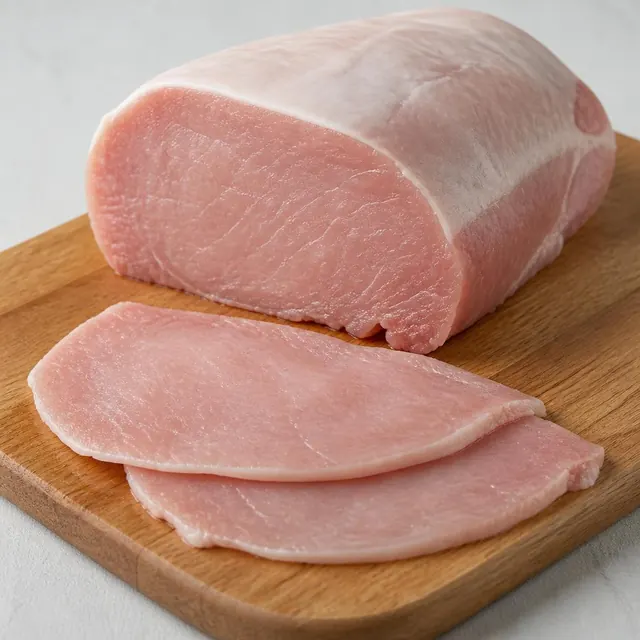
The hind leg of the pork side, divided into muscles – lean meat for schnitzels, roasts and quick pan dishes.
At a glance
- Cut
- Rear of the side: hind leg from the loin to the hind hock, with pelvis and thigh bone.
- Production
- Bone-in, or boneless whole or divided into topside, silverside, thick flank, rump and palec svíčkové.
- Use
- Schnitzels, roasts, quick pan dishes, strips.
- Substitutes
- Tenderloin for pan dishes, shoulder for roasts.
Where on the animal
Pork
- Leg (ham)
An approximate diagram; butchers divide the carcass in slightly different ways from country to country.
The leg is the hind limb of the pork side, with the pelvis and thigh bone. It is separated from the loin by a cut perpendicular to the spine; the hind hock follows below, and the sacrum with the tail is removed from the rump side. Boneless, it is sold whole with a thin layer of fat on the outside, or divided into vrchní šál (topside), spodní šál (silverside), ořech (thick flank), květová špička (rump) and palec svíčkové, the thick end of the tenderloin.
Topside is a compact block for large schnitzels cut across the grain. Silverside is slightly firmer but lean and suits roasting with its rind and fat. Thick flank and the darker, tender rump suit any method, including quick pan cooking; topside, thick flank and rump are also cut into strips.
In German it is Schweinekeule or Schinken, in Austria Schlögel, used mainly for schnitzels.
Techniques and tips
Related entries
Sources
- Sdružení českých spotřebitelů a Česká technologická platforma pro potraviny: Jak poznáme kvalitu? Hovězí a vepřové maso (2012)
- USDA AMS: Institutional Meat Purchase Specifications – Fresh Pork, Series 400 (2014)
- top agrar: Schweinefleisch – alle Teilstücke nutzen (2023)
- ichkoche.at: Was muss ich beim Schweinefleischeinkauf beachten?
- AT Verlag: Leseprobe eines Kochbuchs über Second Cuts von Rind, Kalb und Schwein, mit Bezeichnungen für Deutschland, Schweiz und Österreich (2018, ISBN 978-3-03800-082-2)