Meat cuts · Czech cuisine
Pork loin (chops)
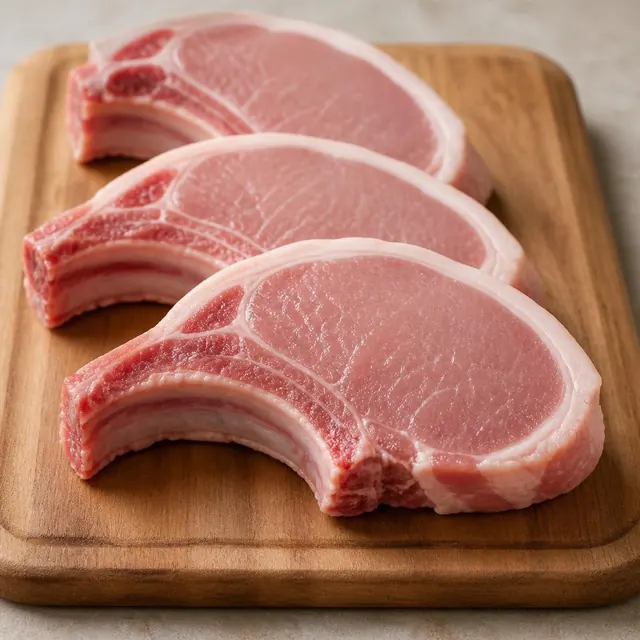
The back of the pork side with the long back muscle – lean meat for chops, schnitzels and whole roasts.
At a glance
- Cut
- Back of the side between the collar and the leg: the long back muscle with vertebrae and ribs.
- Production
- Bone-in as chops, boneless as loin; tenderloin and ribs are taken off.
- Use
- Quick searing, schnitzels, whole roasts.
- Substitutes
- The juicier collar; the leg for lean schnitzels.
Where on the animal
Pork
- Loin
An approximate diagram; butchers divide the carcass in slightly different ways from country to country.
The loin, called kotleta when bone-in, is the back of the pork side between the collar and the leg. It consists of the long back muscle (musculus longissimus) along the spine, with the vertebrae and ribs; the tenderloin lies on its inner side, and between the loin and the belly lies the cut Czech butchers call šněrovačka.
Bone-in it is sold as chops, boneless as a very lean, trimmed back muscle with almost no fat cover. It suits quick searing; the meat next to the bone has the most flavour but must not dry out. Boned loin is cut into schnitzels. Ribs are also taken from the loin.
In German it is Kotelett, the boned back Schweinerücken or Schweinelachs; in Austria Karree, divided into the long Karree near the neck and the short one near the leg.
Recipes
Menus
Techniques and tips
Related entries
Sources
- Sdružení českých spotřebitelů a Česká technologická platforma pro potraviny: Jak poznáme kvalitu? Hovězí a vepřové maso (2012)
- USDA AMS: Institutional Meat Purchase Specifications – Fresh Pork, Series 400 (2014)
- top agrar: Schweinefleisch – alle Teilstücke nutzen (2023)
- ichkoche.at: Was muss ich beim Schweinefleischeinkauf beachten?