Meat cuts · Czech cuisine
Pork collar (neck)
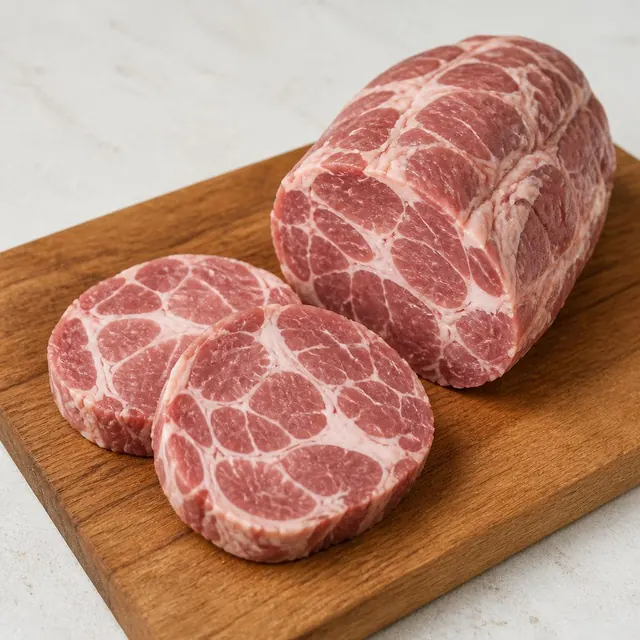
The marbled neck of the pork side, between the head and the loin – juicy for roasting, grilling and richer schnitzels.
At a glance
- Cut
- Front of the side: upper neck between the head and the loin, above the shoulder.
- Production
- Bone-in or boneless, with the blade cartilage removed; the ribs are taken off separately.
- Use
- Roasted whole, grilled, richer schnitzels; ribs roasted, grilled or smoked.
- Substitutes
- Pork shoulder, which is similarly versatile.
Where on the animal
Pork
- Neck (collar)
An approximate diagram; butchers divide the carcass in slightly different ways from country to country.
Krkovice is the upper neck of the pork side. It is separated from the head by a straight cut just behind the back of the skull and runs back into the loin. It lies above the shoulder and against the shoulder blade, so the blade cartilage has to be removed. It is sold bone-in, ribs included, or boned and trimmed.
Thanks to its marbling the meat is juicy and aromatic, so it can take high roasting temperatures. Boned, it is ideal for richer schnitzels, and in recent years it has become popular above all on the grill. The ribs taken from the collar are roasted, grilled or smoked.
In English this is pork collar, in Britain also neck end; the American term Boston butt covers the collar and also the upper shoulder with the blade bone. In German it is Schweinenacken or Kamm, cured as Kasseler; in Austria it is Schopf, roasted as Schopfbraten.
Techniques and tips
Related entries
Sources
- Sdružení českých spotřebitelů a Česká technologická platforma pro potraviny: Jak poznáme kvalitu? Hovězí a vepřové maso (2012)
- AHDB: Meat Purchasing Guide (2019)
- top agrar: Schweinefleisch – alle Teilstücke nutzen (2023)
- AT Verlag: Leseprobe eines Kochbuchs über Second Cuts von Rind, Kalb und Schwein, mit Bezeichnungen für Deutschland, Schweiz und Österreich (2018, ISBN 978-3-03800-082-2)
- ichkoche.at: Was muss ich beim Schweinefleischeinkauf beachten?