Meat cuts · Czech cuisine
Pork belly
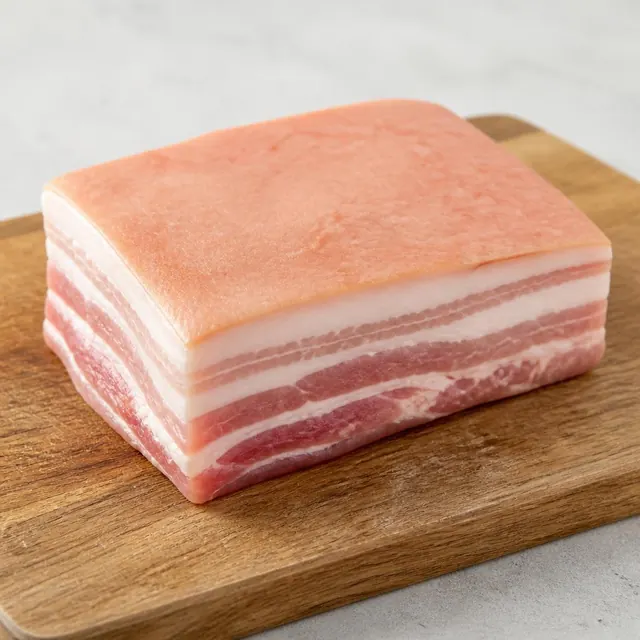
The fatty underside of the pork side with ribs and rind – for roasting, rolled roasts, stuffed belly and ribs.
At a glance
- Cut
- Lower part of the side below the loin, between shoulder and leg; with ribs and breastbone.
- Production
- Bone-in with rind, or boneless and rindless; ribs are taken from it.
- Use
- Roasting, výpečky, stuffed rolls, grilled ribs, greaves.
- Substitutes
- The leaner collar.
Where on the animal
Pork
- Belly
An approximate diagram; butchers divide the carcass in slightly different ways from country to country.
The belly (bok or bůček) is the lower part of the pork side below the loin, between the shoulder and the leg. It contains the ribs with the meat between them, the cartilage ends of the false ribs, the breastbone and the rind. Between loin and belly lies šněrovačka, one of the most tender parts.
Because of its relatively high fat content, belly is best for roasting. The meaty parts near the navel tend to be tougher and are roasted slowly, while the finely marbled middle is the most tender. Boned and rindless, it is used for stuffed pockets, rolled roasts and the Czech výpečky; the lower bone-in belly without rind can stand in for ribs on the grill. With the jowl it is rendered into greaves (škvarky).
In German it is Schweinebauch, in Austria Bauchfleisch. In Italy pancetta is made from belly.
Recipes
Menus
Techniques and tips
Related entries
Sources
- Sdružení českých spotřebitelů a Česká technologická platforma pro potraviny: Jak poznáme kvalitu? Hovězí a vepřové maso (2012)
- USDA AMS: Institutional Meat Purchase Specifications – Fresh Pork, Series 400 (2014)
- ichkoche.at: Was muss ich beim Schweinefleischeinkauf beachten?
- AHDB: Meat Purchasing Guide (2019)