Menu · 2 components
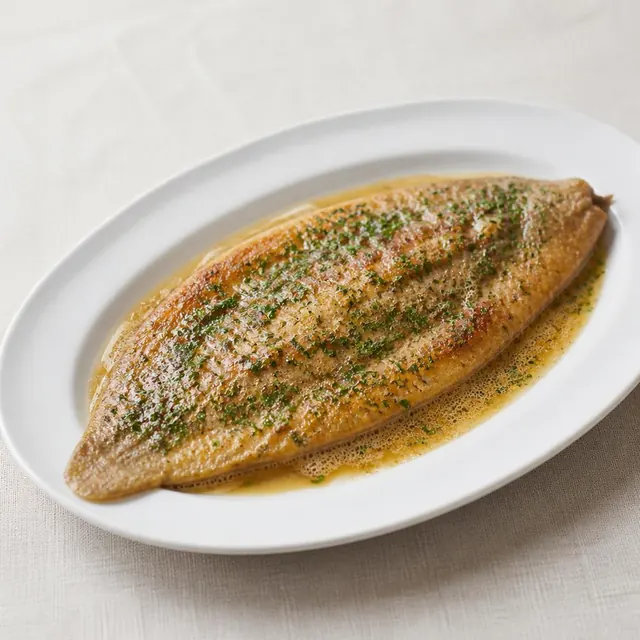
Sole meunière with a side
Sole fried in butter and finished with brown butter, lemon and parsley, with boiled potatoes; buttered green beans or pommes Anna are further choices.
Menu portion59 min461.9 kcal per menu portion
- Good for lunch
- Good for dinner
1Main course
Sole meunière
304 kcal per menu portion · 1 × recipe portion per menu portion
- Low in lactose
Contains: Gluten, Fish, Milk
Quantities for the whole recipe (4 servings).
Ingredients
- 600 gFish, flatfish (flounder and sole species), raw
- 2 gSalt, table
- 0.4 gSpices, pepper, black
- 40 gWheat flour, white, all-purpose, unenriched
- 30 gButter, without salt
- 2 5 ml teaspoonLemon juice, raw
- 4 gParsley, fresh
- 60 gButter, without salt
Method
- Skin the soles on both the dark and the white side (or buy them skinned), trim off the fins, rinse and dry thoroughly. Chop the parsley, dip it into boiling water for a few seconds, drain and squeeze dry.
- Season the fish with salt and pepper and dredge them in flour just before frying; shake off the excess.
- In two large frying pans (or in batches), heat the butter until it stops foaming and is very hot; for larger fish use clarified butter, which browns less. Fry the fish for 4 minutes until golden, turn them over and fry for 3–4 minutes until the flesh at the thickest part comes away from the bone.
TipFish: when is it doneFish has no patience: one minute too long and the fillet becomes a dry jigsaw of flakes.Why and howShow less
Why
Fish flesh is more delicate than the meat of land animals: the muscle fibres are short and held together by thin layers of collagen, which is less heat-stable than mammalian collagen and dissolves at a lower temperature. In fish, the main muscle protein myosin starts to change structure at around 40 °C, so a fillet is done early, and a few degrees more are enough for it to lose its juices, dry out and fall apart. For safety, the US FDA and USDA give 63 °C in the core or, without a thermometer, flesh that turns opaque and separates easily into flakes with a fork; the UK FSA uses the same sign. Cooks often leave salmon or tuna translucent inside, at around 50 °C, which is a culinary choice at your own risk: according to the FDA, pregnant women, young children, older people and anyone with weakened immunity should avoid raw and undercooked fish, and for eating raw or with a translucent centre, choose fish that has been frozen first, because freezing kills parasites (EFSA gives, for example, −20 °C for at least 24 hours), though not all other germs.
How to do it
- Pat the fillet dry with kitchen paper before cooking so it fries rather than steams in the pan.
- Push the thermometer into the thickest part; for fish that is safe for everyone, aim for 63 °C.
- Without a thermometer, try a fork: the fish is done when it is opaque and separates easily into flakes.
- Cook thin fillets for just a few minutes and keep an eye on them; in a hot pan they finish cooking even after the heat is off.
- Prawns are done when they are firm and opaque; throw away any mussels that stay closed during cooking.
- Keep fresh fish in the fridge for 2 days at most, otherwise freeze it, and thaw it overnight in the fridge.
If it goes wrong
Dried-out fish won't turn juicy again; flake it and use it in a spread, fish cakes or a sauce. If it is still raw near the bone, put it back, covered, over a gentle heat or in the oven for a few minutes. Next time take a smaller piece off a little earlier and let carryover heat finish it.
- Transfer the fish to warmed plates, sprinkle with 2 tsp of lemon juice and scatter over the blanched parsley. Pour the fat out of the pan and wipe it clean.
- Put the fresh butter into the pan and heat it until it foams, turns hazelnut brown and smells nutty (about 2 minutes); do not let it blacken. Pour it over the fish at once while still foaming and serve immediately. Without the brown butter, served only with lemon halves, the dish is called “sole dorée”.
TipBrown butter and clarified butterButter isn't pure fat: first its water boils off, then within moments the milk solids brown – to hazelnut, or to black.Why and howShow less
Why
Butter contains roughly 80–82 % fat, about 16 % water and 1–2 % milk solids, that is proteins and milk sugar. As it heats, the water boils first, the butter foams and spits and the temperature stays around 100 °C; once the water has gone, the foam subsides, the temperature climbs quickly and the solids settled on the bottom brown through the Maillard reaction to a nutty aroma – this is brown butter, beurre noisette. Between golden-brown and black, bitter solids there is only a moment; ordinary butter also starts to smoke at roughly 150–175 °C, so it is unsuited to fierce frying. Clarified butter is pure butterfat from which the water has evaporated and the solids have been removed before they brown; for ghee the solids are left to turn golden before straining, so the fat smells nutty. Without water and solids it tolerates roughly 230–250 °C and keeps far longer than butter.
How to do it
- Make brown butter in a light-coloured pan or saucepan over medium heat and swirl the pan so you can see the colour of the solids under the foam.
- As soon as the foam subsides, the specks on the bottom turn golden and the butter smells of hazelnuts, pour it straight into a cold bowl; in the hot pan it would keep darkening.
- For clarified butter, melt butter over gentle heat, skim off the white foam and carefully pour the clear yellow fat off the milky layer at the bottom.
- For ghee, keep the butter simmering gently until it stops spitting and the solids on the bottom turn golden, then strain it through muslin or a paper filter.
- Keep clarified butter and ghee in a clean, dry, closed jar somewhere cool and scoop with a dry spoon; water and crumbs shorten their life.
- For searing and frying, use clarified butter or ghee; plain butter belongs over gentle heat, and with fierce heat add it to the oil only at the end, for flavour.
If it goes wrong
Butter with just a few dark specks: pour it quickly into a cold bowl, strain it through a fine sieve or paper and taste; it is often still good. Black solids and an acrid, bitter smell can't be fixed – pour the butter away and start again, it only takes a few minutes. If ghee turns grainy as it sets, that's fine; the fat has simply crystallised. Reheat cloudy clarified butter with droplets of water at the bottom once more until the water has gone, and strain it.
2Side dish
Boiled potatoes without butter traditional
158 kcal per menu portion · 1 × recipe portion per menu portion
- Vegan
- Lactose free
- Gluten free
Contains none of the 14 main allergens.
Quantities for the whole recipe (4 servings).
or:
- Buttered green beans (haricots verts au beurre) · 230 kcal per menu portion
- Potato cake (pommes Anna) · 308 kcal per menu portion
Ingredients
- 800 gPotatoes, russet, flesh and skin, raw (Includes foods for USDA's Food Distribution Program)
Method
- Wash skin-on potatoes and cut into even pieces.
- Cover with water, bring to a boil and cook 18 minutes until tender.
- Drain and serve without butter.
Alternative: Buttered green beans (haricots verts au beurre)
2Side dish
Buttered green beans (haricots verts au beurre)
Quantities for the whole recipe (4 servings).
Ingredients
- 500 gGreen beans, raw
- 3 lBeverages, water, tap, drinking not counted – removed
- 3 gSalt, table editorial addition
- 2 gSalt, table
- 0.4 gSpices, pepper, black
- 100 gButter, without salt
Method
- Top and tail the beans and remove the string if they have one. Bring 3 litres of water with 30 g of salt to the boil in a wide pot.
- Add the beans and boil them hard, uncovered, for 6–8 minutes until they are slightly firm to the bite but no longer hard. Drain them and do not refresh them in cold water.
TipGreen vegetables and chlorophyllBroccoli only turns brilliant green once: at the start of cooking. After that it just waits to be rescued before it goes grey.Why and howShow less
Why
The green colour of vegetables comes from chlorophyll, which has a magnesium atom at its centre; in acidic conditions hydrogen pushes it out and the bright green pigment turns olive brown. The vegetable releases acid itself as heat damages its cells, so the longer it cooks, the more olive it gets; lemon juice or vinegar added to the water has the same effect. In tests a lid made no difference to the colour; what matters most is cooking time. Baking soda makes the water alkaline and keeps the colour, but it quickly softens vegetables to mush and destroys some vitamins, mainly vitamin C and thiamin, so it isn't worth it. Blanching means cooking briefly in plenty of boiling water until the vegetables turn bright green and are tender but firm, then plunging them straight into ice water to stop the cooking.
How to do it
- Cut the vegetables into evenly sized pieces and drop them into a large pot of rapidly boiling water.
- Cook for just a few minutes, until bright green and tender but firm; taste as you go.
- Drain them at once and plunge them into ice water; once cool, drain and pat dry.
- Add lemon juice, vinegar and sharp dressings only just before serving.
- Don't add baking soda to the water and don't worry about the lid; watch the time above all.
If it goes wrong
Olive colour can't be reversed; blend overcooked vegetables into a soup or purée where the colour matters less. In dishes where greens braise for a long time in a sauce, such as saag or Greek green beans, an olive colour is normal and belongs to them. Next time cook the vegetables for less time and cool them straight away.
- Return the beans to the dry pot and toss them over the heat for a minute or two until the moisture has evaporated. Season with 2 g of salt and the pepper.
- Add 100 g of very fresh butter cut into small pieces and toss the beans with it away from fierce heat until the butter has melted and coats them. Serve at once.
Alternative: Potato cake (pommes Anna)
Ingredients
- 1,000 gPotatoes, flesh and skin, raw
- 150 gButter, without salt
- 8 gSalt, table
- 1 gSpices, pepper, black
Method
- Heat the oven to 220 °C. Peel the potatoes, trim them into cylinders about 4 cm across and cut them into rounds 2 mm thick. Rinse the rounds in cold water and dry them thoroughly in a cloth. Melt 150 g of butter.
- Brush a heavy ovenproof pan 22–24 cm across with butter. Arrange the rounds on the bottom in overlapping circles, reversing the direction of each circle. Season the layer with salt and pepper and brush it with melted butter.
- Build up another 4–5 layers in the same way, seasoning each and brushing it with butter; pour the rest of the butter over the top. Cover the pan with a lid or foil.
- Bake covered at 220 °C for 30 minutes. If the bottom is already golden brown but the top is pale, turn the cake out onto a lid, slide it back into the pan and bake uncovered for another 10 minutes so that it colours evenly. The potatoes must be tender inside; a knife should slide in without resistance.
- Turn the cake out onto a lid, let the excess butter drain off, then slide it onto a warmed plate. Cut into 6 wedges and serve at once.
Allergens
Contains: Fish, Gluten, Milk
Derived from ingredients – check the package label.
Nutrition, allergens and calories are for the default choice – the first alternative of every slot.
Nutrition per menu portion
Per serving
- Protein24.2 g21%
- Fat21.4 g41%
- Total carbohydrate (by difference)44.1 g38%
Share of energy from protein, fat and carbohydrate (4 / 9 / 4 kcal per g), not share by weight.
- Energy
- 461.9 kcal
- Protein
- 24.2 g
- Fat
- 21.4 g
- Total carbohydrate (by difference)
- 44.1 g
- Total dietary fibre (USDA)
- 2.9 g
- Saturated fatty acids
- 12.1 g
- Sodium
- 651.1 mg
- Salt (sodium × 2.5)
- 1.6 g
Per 100 g
- Energy
- 133.9 kcal
- Protein
- 7 g
- Fat
- 6.2 g
- Total carbohydrate (by difference)
- 12.8 g
- Total dietary fibre (USDA)
- 0.85 g
- Saturated fatty acids
- 3.5 g
- Sodium
- 188.7 mg
- Salt (sodium × 2.5)
- 0.47 g
A dash means the value is unknown, not zero. Salt is calculated from sodium (g salt = mg sodium × 2.5 / 1000) and includes sodium from all ingredients.
Calculation limitations
- Nutrition is a calculated estimate, not a laboratory measurement.
- Some ingredient quantities use documented estimates or household-measure assumptions.
- The number of servings is an editorial estimate (midpoint of the source range or based on the dish type and energy).
- Fibre, saturated fat and sodium of cooked ingredients are estimated from the consumed ingredient amounts; for drained ingredients, sodium is included only where the retained amount is an explicit editorial estimate.
- Some process effects could not be resolved in this calculation.
- Menu nutrition is the sum of its component recipes, each scaled to one menu portion.