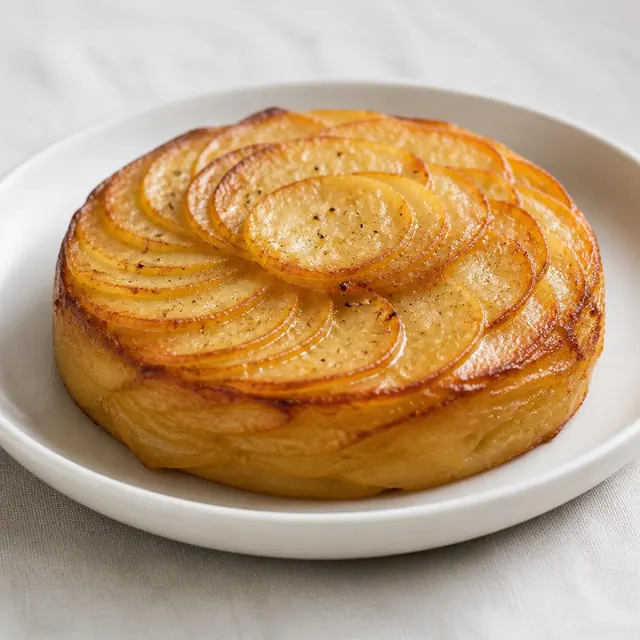
Potato cake (pommes Anna)
French side dish of thinly sliced potatoes layered in overlapping circles in a pan, each layer seasoned and brushed with butter, baked covered and turned out as a golden cake; following A. Escoffier (Le Guide culinaire, 2nd ed. 1907). 6 servings of about 150 g, one per serving of a main dish.
Total time: 85 min6 servingsFinal yield 900 g
Ingredients
- 1,000 gPotatoes, flesh and skin, raw
- 150 gButter, without salt
- 8 gSalt, table
- 1 gSpices, pepper, black
Allergens
Contains: Milk
Derived from ingredients – check the package label.
Method
- Heat the oven to 220 °C. Peel the potatoes, trim them into cylinders about 4 cm across and cut them into rounds 2 mm thick. Rinse the rounds in cold water and dry them thoroughly in a cloth. Melt 150 g of butter.
- Brush a heavy ovenproof pan 22–24 cm across with butter. Arrange the rounds on the bottom in overlapping circles, reversing the direction of each circle. Season the layer with salt and pepper and brush it with melted butter.
- Build up another 4–5 layers in the same way, seasoning each and brushing it with butter; pour the rest of the butter over the top. Cover the pan with a lid or foil.
- Bake covered at 220 °C for 30 minutes. If the bottom is already golden brown but the top is pale, turn the cake out onto a lid, slide it back into the pan and bake uncovered for another 10 minutes so that it colours evenly. The potatoes must be tender inside; a knife should slide in without resistance.
- Turn the cake out onto a lid, let the excess butter drain off, then slide it onto a warmed plate. Cut into 6 wedges and serve at once.
Recipe tradition
Not yet verified
This recipe has not been checked against a documented culinary reference.
Food data sources
- USDA FoodData Central SR Legacy (2018-04) · USDA Agricultural Research Service, FoodData Central SR Legacy. · CC0 1.0 Universal
Nutrition
Calculated from the selected ingredients; not a laboratory measurement.
Whole recipe
- Energy
- 1,848 kcal
- Protein
- 21.9 g
- Fat
- 122.6 g
- Total carbohydrate (by difference)
- 175.6 g
- Total dietary fibre (USDA)
- 21.3 g
- Saturated fatty acids
- 76 g
- Sodium
- 3,177.3 mg
- Salt (sodium × 2.5)
- 7.9 g
Per serving
- Protein3.6 g5%
- Fat20.4 g58%
- Total carbohydrate (by difference)29.3 g37%
Share of energy from protein, fat and carbohydrate (4 / 9 / 4 kcal per g), not share by weight.
- Energy
- 308 kcal
- Protein
- 3.6 g
- Fat
- 20.4 g
- Total carbohydrate (by difference)
- 29.3 g
- Total dietary fibre (USDA)
- 3.5 g
- Saturated fatty acids
- 12.7 g
- Sodium
- 529.6 mg
- Salt (sodium × 2.5)
- 1.3 g
Per 100 g of finished food
- Energy
- 205.3 kcal
- Protein
- 2.4 g
- Fat
- 13.6 g
- Total carbohydrate (by difference)
- 19.5 g
- Total dietary fibre (USDA)
- 2.4 g
- Saturated fatty acids
- 8.4 g
- Sodium
- 353 mg
- Salt (sodium × 2.5)
- 0.88 g
Salt is calculated from sodium (g salt = mg sodium × 2.5 / 1000) and includes sodium from all ingredients.
A dash means the value is unknown, not zero.
Calculation limitations
- Nutrition is a calculated estimate, not a laboratory measurement.
- The final yield is an editorial estimate.
- Some ingredient quantities use documented estimates or household-measure assumptions.
- The number of servings is an editorial estimate (midpoint of the source range or based on the dish type and energy).
- Some specific ingredients are represented by the closest generic food with the same culinary function.
- Fibre, saturated fat and sodium of cooked ingredients are estimated from the consumed ingredient amounts; for drained ingredients, sodium is included only where the retained amount is an explicit editorial estimate.
- Some process effects could not be resolved in this calculation.