Menu · 3 components
Baked salmon with hollandaise sauce
Baked salmon with hollandaise sauce and boiled potatoes; maître d’hôtel butter or aïoli (half serving) are further sauces, buttered green beans or pommes Anna further sides.
Menu portion77 min794.4 kcal per menu portion
- Good for lunch
- Good for dinner
1Main course
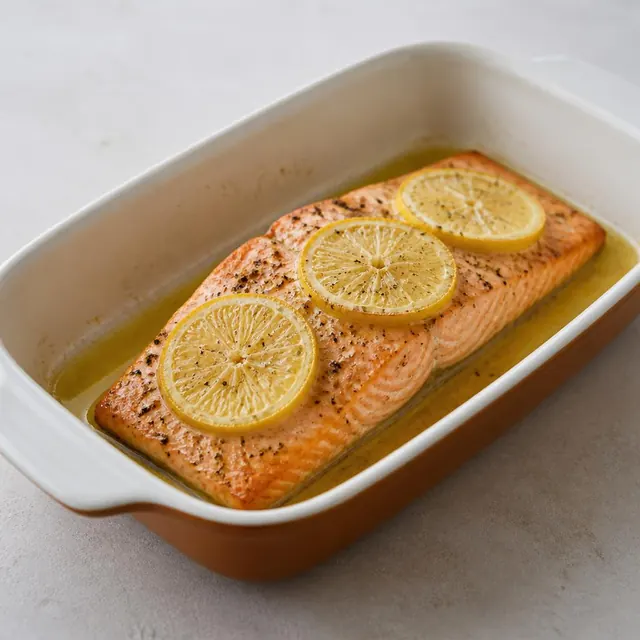
Baked salmon with lemon
250 kcal per menu portion · 1 × recipe portion per menu portion
- Lactose free
- Gluten free
Contains: Fish
Quantities for the whole recipe (4 servings).
Ingredients
- 600 gFish, salmon, Atlantic, wild, raw
- 80 gLemons, raw, without peel
- 1 15 ml tablespoonOil, olive, salad or cooking
- 3 gSalt, table
- 1 gSpices, pepper, black
Method
- Heat the oven to 200 °C. Pat the salmon dry, divide it into four similar pieces and place them in a small baking dish.
- Rub with 1 tbsp oil, season with salt and pepper and place a lemon slice on each piece.
- Bake at 200 °C for 12–15 minutes, until the fish separates easily with a fork but remains moist in the centre. Rest for three minutes.
TipFish: when is it doneFish has no patience: one minute too long and the fillet becomes a dry jigsaw of flakes.Why and howShow less
Why
Fish flesh is more delicate than the meat of land animals: the muscle fibres are short and held together by thin layers of collagen, which is less heat-stable than mammalian collagen and dissolves at a lower temperature. In fish, the main muscle protein myosin starts to change structure at around 40 °C, so a fillet is done early, and a few degrees more are enough for it to lose its juices, dry out and fall apart. For safety, the US FDA and USDA give 63 °C in the core or, without a thermometer, flesh that turns opaque and separates easily into flakes with a fork; the UK FSA uses the same sign. Cooks often leave salmon or tuna translucent inside, at around 50 °C, which is a culinary choice at your own risk: according to the FDA, pregnant women, young children, older people and anyone with weakened immunity should avoid raw and undercooked fish, and for eating raw or with a translucent centre, choose fish that has been frozen first, because freezing kills parasites (EFSA gives, for example, −20 °C for at least 24 hours), though not all other germs.
How to do it
- Pat the fillet dry with kitchen paper before cooking so it fries rather than steams in the pan.
- Push the thermometer into the thickest part; for fish that is safe for everyone, aim for 63 °C.
- Without a thermometer, try a fork: the fish is done when it is opaque and separates easily into flakes.
- Cook thin fillets for just a few minutes and keep an eye on them; in a hot pan they finish cooking even after the heat is off.
- Prawns are done when they are firm and opaque; throw away any mussels that stay closed during cooking.
- Keep fresh fish in the fridge for 2 days at most, otherwise freeze it, and thaw it overnight in the fridge.
If it goes wrong
Dried-out fish won't turn juicy again; flake it and use it in a spread, fish cakes or a sauce. If it is still raw near the bone, put it back, covered, over a gentle heat or in the oven for a few minutes. Next time take a smaller piece off a little earlier and let carryover heat finish it.
2Sauce
Hollandaise sauce traditional
387 kcal per menu portion · 1 × recipe portion per menu portion
- Vegetarian
- Low in lactose
- Gluten free
Contains: Egg, Milk, Sulphites
Quantities for the whole recipe (4 servings).
or:
- Maître d'hôtel butter · 144 kcal per menu portion
- Garlic sauce (aïoli) · 285 kcal per menu portion
Ingredients
- 200 gButter, without salt
- 34 gEgg, yolk, raw, fresh
- 2 15 ml tablespoonBeverages, water, tap, drinking
- 1 15 ml tablespoonWhite wine vinegar
- 0.3 gSpices, pepper, black not counted – removed
- 3 gSalt, table
- 1 5 ml teaspoonBeverages, water, tap, drinking
- 1.5 15 ml tablespoonBeverages, water, tap, drinking
- 0.5 5 ml teaspoonLemon juice, raw
Method
- Melt the butter over low heat and keep it warm (about 50–60 °C). Put 2 tbsp of water, 1 tbsp of vinegar, the crushed pepper and a pinch of salt into a small heavy-based saucepan and reduce by two thirds until about 1 tbsp of liquid remains.
TipReducing a sauceReduction boils off the water but keeps the salt: a sauce that was just right can easily end up as brine.Why and howShow less
Why
When you reduce a sauce, simmering it uncovered, water evaporates while flavour compounds, sugars, gelatin from meat and bones and salt stay in the pan, so they become concentrated and the sauce thickens. If you salt it at the start and then reduce it by half, it will be roughly twice as salty – which is why seasoning is adjusted at the end. The brown bits stuck to the bottom of the pan or roasting tin after searing or roasting (the fond) are among the tastiest parts of a sauce: poured over with stock, wine or water and scraped up, they dissolve into the sauce – this is called deglazing. A gentle simmer is enough; at a hard boil the sauce easily scorches at the edges and on the bottom, and if it contains a lot of sugar or gelatin it reduces into a sticky mass.
How to do it
- Cook uncovered in a wider pan so the water evaporates faster.
- Salt only at the end, once the sauce has the thickness you want.
- Pour hot stock, wine or water over the fond and scrape it off the bottom with a wooden spoon; leave out black, burnt bits, they would make the sauce bitter.
- Keep only a gentle simmer and stir now and then, especially at the bottom and the edges.
- Test the thickness on a spoon: the sauce should coat it thinly; bear in mind it will thicken further as it cools.
If it goes wrong
An oversalted sauce can only be saved by diluting it: add unsalted stock, water or cream and bring the thickness back with a short simmer. Thin a sauce that is too thick or sticky with a little hot water. Pour a scorched sauce into a clean pan at once without scraping the bottom; if it already tastes burnt, it can't be saved.
- Set the saucepan in a hot water bath kept well below simmering, add 1 tsp of cold water and the yolks, whisk them briefly and start mounting with the butter straight away; do not let the yolks get hotter than about 65 °C.
TipHollandaise and mounting with butterHollandaise lives in a narrow temperature window: let it cool and it sets, a few degrees too hot and it's scrambled eggs.Why and howShow less
Why
Hollandaise is a warm emulsion: droplets of melted butterfat dispersed in the water from the yolks, the butter and the lemon juice or reduction, coated with lecithin and proteins from the yolk. The yolks thicken the sauce once they reach roughly 65 °C, but above about 70 °C their proteins curdle into grains and the emulsion falls apart – which is why it is whisked over a water bath or on very gentle heat. If the sauce cools down instead, the butter firms up and the sauce thickens until it sets, and if too much butter meets too little water, the droplets merge and the sauce splits much like an overloaded mayonnaise. Mounting a sauce with butter works on the same principle without the yolk: cold butter whisked piece by piece into a hot but not boiling reduction disperses into tiny droplets that the butter's own proteins and emulsifiers hold in place – until you overheat the sauce or bring it to the boil.
How to do it
- Whisk the yolks with a little water, lemon juice or reduction over a water bath that is barely simmering and doesn't touch the bowl.
- Whisk until the mixture thickens and the whisk leaves a trail; lift the bowl off the steam now and then.
- Add warm, not hot, melted butter drop by drop at first, then in a thin stream.
- Keep the finished sauce in a bowl over warm water off the hob and serve it as soon as you can.
- To mount a sauce, take the reduction off the heat and whisk in cold butter cube by cube, adding the next once the last has melted; then don't let it boil.
- For children, pregnant women, older people and the immunocompromised, use pasteurised yolks: a sauce kept below 70 °C won't reliably kill salmonella.
If it goes wrong
If the sauce starts to turn grainy or greasy, take it off the heat at once and whisk in a spoonful of cold water. If it has split completely, put a fresh yolk with a spoonful of warm water in a clean bowl and whisk the broken sauce into it a teaspoon at a time. Warm a sauce that has cooled and set over a water bath, whisking constantly. Badly curdled lumps of yolk can't be fixed – strain the sauce or start again.
- Whisking briskly all the time, pour in the warm butter, drop by drop at first and then in a thin stream. While mounting, add a total of 1½ tbsp of water a little at a time; it makes the sauce lighter.
- Adjust the salt, season with ½ tsp of lemon juice and pass the sauce through a fine sieve or cloth (it catches the pepper). Keep it only lukewarm in the water bath and serve as soon as possible; overheating makes it split and it cannot be reheated.
Alternative: Maître d'hôtel butter
Ingredients
- 100 gButter, without salt
- 2.5 gParsley, fresh
- 3.2 gSalt, table
- 0.4 gSpices, pepper, black
- 1 5 ml teaspoonLemon juice, raw
Method
- Let the butter soften at room temperature, knead it and beat it with a wooden spoon into a smooth cream.
- Mix in the finely chopped parsley, salt, pepper and 1 tsp of lemon juice.
- Serve the butter soft, or roll it into a log in baking paper, chill it and slice it into rounds. Place them on hot grilled meat or fish just before serving.
Alternative: Garlic sauce (aïoli)
Ingredients
- 24 gGarlic, raw
- 0.4 gSalt, table
- 17 gEgg, yolk, raw, fresh
- 270 mlOil, olive, salad or cooking
- 2 15 ml tablespoonLemon juice, raw
- 1 15 ml tablespoonBeverages, water, tap, drinking
Method
- Let the ingredients come to room temperature. Peel the garlic, put it into a mortar and pound it to a smooth paste with the pestle. Add a pinch of salt and the yolk and stir briefly.
TipRaw and undercooked eggsSalmonella can be inside an intact egg; make raw-egg creams with pasteurised eggs, or hold the cream at 71 °C for 2 minutes.Why and howShow less
Why
Salmonella bacteria can be on the shell and inside the egg, according to BfR mainly in the yolk, and the US FDA warns that even a clean egg with an intact shell can carry them; few eggs are contaminated, but in a raw-egg dish left standing warm the bacteria multiply quickly. Heat destroys them: BfR states that they die from 70 °C, and the FDA wants egg dishes cooked to 71 °C, whereas tiramisu, homemade mayonnaise, yolk creams and mousses made with raw yolks or whites never pass through any heat. Pasteurised eggs are therefore the safer choice, or a cream in which the yolks are whisked over steam until a thermometer shows 71 °C, then for 2 more minutes. Most at risk are young children, pregnant women, older people and anyone with weakened immunity, who according to BfR and the FDA should eat eggs only when thoroughly cooked, with firm yolk and white, or dishes made with pasteurised eggs. A cracked or dirty shell and warmth raise the risk, which is why BfR advises keeping eggs and egg dishes in the fridge at no more than 7 °C.
How to do it
- For tiramisu, homemade mayonnaise, yolk creams and mousses that are not cooked further, use pasteurised eggs or pasteurised liquid yolk and white.
- Without pasteurised eggs, whisk the yolks with sugar or wine over steam until a thermometer shows 71 °C, keep whisking for 2 more minutes at 70–71 °C, then cool the cream at once in iced water.
- Buy eggs with clean, uncracked shells and keep them in the fridge; use an egg that cracked by accident only in a dish you will cook thoroughly.
- Serve a raw-egg dish straight away, or keep it covered in the fridge at no more than 7 °C and eat it within 24 hours, like mayonnaise (Mayonnaise and dressings card).
- Give young children, pregnant women, older people and anyone with weakened immunity only eggs with firm yolk and white, or dishes made with pasteurised eggs.
- Do not taste raw dough or raw-egg cream; after handling raw eggs wash your hands, and wash bowls and whisk with detergent.
If it goes wrong
Throw away a cream, mousse or mayonnaise made with raw eggs that has stood warm for more than 2 hours; taste and smell give no sign of salmonella, and the cream can no longer be heated. Serve finished tiramisu made with raw yolks only to healthy adults, keep it in the fridge and eat it within 24 hours. If diarrhoea, fever and stomach cramps appear after eating, drink plenty of fluids; young children, pregnant women, older people and anyone with weakened immunity, or anyone with blood in the stool or a high fever, should see a doctor.
- Pour in the 270 ml of oil in a very thin stream while turning the pestle constantly (never stop). After the first 2–3 tablespoons of oil, work in 2 tbsp of lemon juice and 1 tbsp of lukewarm water, then carry on with the oil. The result should be a thick, firm ointment-like paste.
TipMayonnaise and dressingsOil and water can't stand each other; egg yolk is the diplomat that keeps them at the same table.Why and howShow less
Why
Mayonnaise is an emulsion: millions of tiny oil droplets dispersed in the little water that comes from the yolk and the lemon juice or vinegar. To stop the droplets merging again, they get coated with emulsifiers from the yolk – lecithin and other phospholipids together with proteins; mustard helps a little too. At the start there is so little water that it can't break a big splash of oil into droplets or coat them, so the oil goes in drop by drop at first and faster only once the emulsion has thickened. Cold ingredients come together a little less readily, so it helps if the yolk and oil are at the same temperature, ideally room temperature – and a mayonnaise that is very stiff with a greasy sheen is short of water, not of yolk. An oil-and-vinegar dressing is only a temporary emulsion: mustard or honey hold it together for a while, but sooner or later it separates.
How to do it
- Take the yolk, oil and mustard out of the fridge about half an hour ahead – at room temperature the emulsion forms more readily. Don't leave raw yolk standing any longer.
- Whisk the yolk with a teaspoon of mustard and a little vinegar or lemon juice before any oil goes in.
- Add the oil literally drop by drop at first, whisking constantly; speed up only once it thickens.
- If the mayonnaise is stiff and looks greasy, whisk in a teaspoon of water or lemon juice.
- Raw yolk can carry salmonella even from a fresh egg: pasteurised yolk is safest, and never serve raw-yolk mayonnaise to pregnant women, young children, older people or the immunocompromised.
- Put the finished mayonnaise straight in the fridge and eat it within 24 hours; shake or whisk a dressing again just before serving.
If it goes wrong
Broken mayonnaise can be saved: put a fresh yolk, or a spoonful of water or mustard, into a clean bowl and whisk in the broken mixture drop by drop, as if it were oil. Once the emulsion takes, add the rest faster. Never the other way round – stirring a new yolk into the broken sauce won't help.
- Whenever the sauce becomes too thick again, work in a few drops of water; otherwise the oil separates. If it splits, take it out of the mortar, put a fresh yolk with a few drops of lemon in the bottom and work the split sauce back in spoon by spoon, turning the pestle all the time.
- Serve in the mortar or a bowl with poached salt cod, vegetables and hard-boiled eggs (aïoli garni).
3Side dish
Boiled potatoes without butter traditional
158 kcal per menu portion · 1 × recipe portion per menu portion
- Vegan
- Lactose free
- Gluten free
Contains none of the 14 main allergens.
Quantities for the whole recipe (4 servings).
or:
- Buttered green beans (haricots verts au beurre) · 230 kcal per menu portion
- Potato cake (pommes Anna) · 308 kcal per menu portion
Ingredients
- 800 gPotatoes, russet, flesh and skin, raw (Includes foods for USDA's Food Distribution Program)
Method
- Wash skin-on potatoes and cut into even pieces.
- Cover with water, bring to a boil and cook 18 minutes until tender.
- Drain and serve without butter.
Alternative: Buttered green beans (haricots verts au beurre)
3Side dish
Buttered green beans (haricots verts au beurre)
Quantities for the whole recipe (4 servings).
Ingredients
- 500 gGreen beans, raw
- 3 lBeverages, water, tap, drinking not counted – removed
- 3 gSalt, table editorial addition
- 2 gSalt, table
- 0.4 gSpices, pepper, black
- 100 gButter, without salt
Method
- Top and tail the beans and remove the string if they have one. Bring 3 litres of water with 30 g of salt to the boil in a wide pot.
- Add the beans and boil them hard, uncovered, for 6–8 minutes until they are slightly firm to the bite but no longer hard. Drain them and do not refresh them in cold water.
TipGreen vegetables and chlorophyllBroccoli only turns brilliant green once: at the start of cooking. After that it just waits to be rescued before it goes grey.Why and howShow less
Why
The green colour of vegetables comes from chlorophyll, which has a magnesium atom at its centre; in acidic conditions hydrogen pushes it out and the bright green pigment turns olive brown. The vegetable releases acid itself as heat damages its cells, so the longer it cooks, the more olive it gets; lemon juice or vinegar added to the water has the same effect. In tests a lid made no difference to the colour; what matters most is cooking time. Baking soda makes the water alkaline and keeps the colour, but it quickly softens vegetables to mush and destroys some vitamins, mainly vitamin C and thiamin, so it isn't worth it. Blanching means cooking briefly in plenty of boiling water until the vegetables turn bright green and are tender but firm, then plunging them straight into ice water to stop the cooking.
How to do it
- Cut the vegetables into evenly sized pieces and drop them into a large pot of rapidly boiling water.
- Cook for just a few minutes, until bright green and tender but firm; taste as you go.
- Drain them at once and plunge them into ice water; once cool, drain and pat dry.
- Add lemon juice, vinegar and sharp dressings only just before serving.
- Don't add baking soda to the water and don't worry about the lid; watch the time above all.
If it goes wrong
Olive colour can't be reversed; blend overcooked vegetables into a soup or purée where the colour matters less. In dishes where greens braise for a long time in a sauce, such as saag or Greek green beans, an olive colour is normal and belongs to them. Next time cook the vegetables for less time and cool them straight away.
- Return the beans to the dry pot and toss them over the heat for a minute or two until the moisture has evaporated. Season with 2 g of salt and the pepper.
- Add 100 g of very fresh butter cut into small pieces and toss the beans with it away from fierce heat until the butter has melted and coats them. Serve at once.
Alternative: Potato cake (pommes Anna)
Ingredients
- 1,000 gPotatoes, flesh and skin, raw
- 150 gButter, without salt
- 8 gSalt, table
- 1 gSpices, pepper, black
Method
- Heat the oven to 220 °C. Peel the potatoes, trim them into cylinders about 4 cm across and cut them into rounds 2 mm thick. Rinse the rounds in cold water and dry them thoroughly in a cloth. Melt 150 g of butter.
- Brush a heavy ovenproof pan 22–24 cm across with butter. Arrange the rounds on the bottom in overlapping circles, reversing the direction of each circle. Season the layer with salt and pepper and brush it with melted butter.
- Build up another 4–5 layers in the same way, seasoning each and brushing it with butter; pour the rest of the butter over the top. Cover the pan with a lid or foil.
- Bake covered at 220 °C for 30 minutes. If the bottom is already golden brown but the top is pale, turn the cake out onto a lid, slide it back into the pan and bake uncovered for another 10 minutes so that it colours evenly. The potatoes must be tender inside; a knife should slide in without resistance.
- Turn the cake out onto a lid, let the excess butter drain off, then slide it onto a warmed plate. Cut into 6 wedges and serve at once.
Allergens
Contains: Egg, Fish, Milk, Sulphites
Derived from ingredients – check the package label.
Nutrition, allergens and calories are for the default choice – the first alternative of every slot.
Nutrition per menu portion
Per serving
- Protein36.1 g18%
- Fat56 g63%
- Total carbohydrate (by difference)38.6 g19%
Share of energy from protein, fat and carbohydrate (4 / 9 / 4 kcal per g), not share by weight.
- Energy
- 794.4 kcal
- Protein
- 36.1 g
- Fat
- 56 g
- Total carbohydrate (by difference)
- 38.6 g
- Total dietary fibre (USDA)
- 3.2 g
- Saturated fatty acids
- 28.1 g
- Sodium
- 668.3 mg
- Salt (sodium × 2.5)
- 1.7 g
Per 100 g
- Energy
- 191.4 kcal
- Protein
- 8.7 g
- Fat
- 13.5 g
- Total carbohydrate (by difference)
- 9.3 g
- Total dietary fibre (USDA)
- 0.78 g
- Saturated fatty acids
- 6.8 g
- Sodium
- 161 mg
- Salt (sodium × 2.5)
- 0.4 g
A dash means the value is unknown, not zero. Salt is calculated from sodium (g salt = mg sodium × 2.5 / 1000) and includes sodium from all ingredients.
Calculation limitations
- Nutrition is a calculated estimate, not a laboratory measurement.
- Some ingredient quantities use documented estimates or household-measure assumptions.
- The number of servings is an editorial estimate (midpoint of the source range or based on the dish type and energy).
- Some specific ingredients are represented by the closest generic food with the same culinary function.
- Fibre, saturated fat and sodium of cooked ingredients are estimated from the consumed ingredient amounts; for drained ingredients, sodium is included only where the retained amount is an explicit editorial estimate.
- Some process effects could not be resolved in this calculation.
- Menu nutrition is the sum of its component recipes, each scaled to one menu portion.