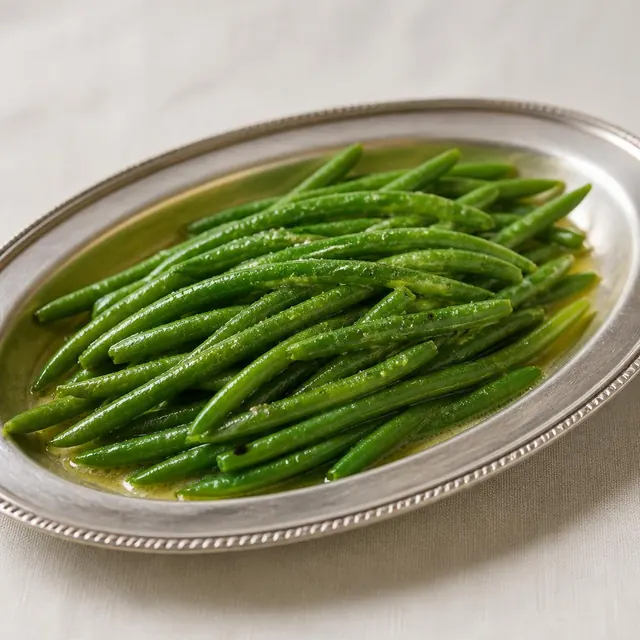
Buttered green beans (haricots verts au beurre)
Fresh fine green beans boiled in salted water until just tender, not refreshed but dried over the heat and tossed with fresh butter; following A. Escoffier (Le Guide culinaire, 2nd ed. 1907). 4 servings of about 142 g, one per serving of a main dish.
Total time: 25 min4 servingsFinal yield 570 g
Ingredients
- 500 gGreen beans, raw
- 3 lBeverages, water, tap, drinking not counted – removed
- 3 gSalt, table editorial addition
- 2 gSalt, table
- 0.4 gSpices, pepper, black
- 100 gButter, without salt
Allergens
Contains: Milk
Derived from ingredients – check the package label.
Method
- Top and tail the beans and remove the string if they have one. Bring 3 litres of water with 30 g of salt to the boil in a wide pot.
- Add the beans and boil them hard, uncovered, for 6–8 minutes until they are slightly firm to the bite but no longer hard. Drain them and do not refresh them in cold water.
TipGreen vegetables and chlorophyllBroccoli only turns brilliant green once: at the start of cooking. After that it just waits to be rescued before it goes grey.Show less
Why
The green colour of vegetables comes from chlorophyll, which has a magnesium atom at its centre; in acidic conditions hydrogen pushes it out and the bright green pigment turns olive brown. The vegetable releases acid itself as heat damages its cells, so the longer it cooks, the more olive it gets; lemon juice or vinegar added to the water has the same effect. In tests a lid made no difference to the colour; what matters most is cooking time. Baking soda makes the water alkaline and keeps the colour, but it quickly softens vegetables to mush and destroys some vitamins, mainly vitamin C and thiamin, so it isn't worth it. Blanching means cooking briefly in plenty of boiling water until the vegetables turn bright green and are tender but firm, then plunging them straight into ice water to stop the cooking.
How to do it
- Cut the vegetables into evenly sized pieces and drop them into a large pot of rapidly boiling water.
- Cook for just a few minutes, until bright green and tender but firm; taste as you go.
- Drain them at once and plunge them into ice water; once cool, drain and pat dry.
- Add lemon juice, vinegar and sharp dressings only just before serving.
- Don't add baking soda to the water and don't worry about the lid; watch the time above all.
If it goes wrong
Olive colour can't be reversed; blend overcooked vegetables into a soup or purée where the colour matters less. In dishes where greens braise for a long time in a sauce, such as saag or Greek green beans, an olive colour is normal and belongs to them. Next time cook the vegetables for less time and cool them straight away.
- Return the beans to the dry pot and toss them over the heat for a minute or two until the moisture has evaporated. Season with 2 g of salt and the pepper.
- Add 100 g of very fresh butter cut into small pieces and toss the beans with it away from fierce heat until the butter has melted and coats them. Serve at once.
Recipe tradition
Not yet verified
This recipe has not been checked against a documented culinary reference.
Food data sources
- USDA FoodData Central FNDDS (2021-2023) · USDA Agricultural Research Service, FoodData Central FNDDS. · CC0 1.0 Universal
- USDA FoodData Central SR Legacy (2018-04) · USDA Agricultural Research Service, FoodData Central SR Legacy. · CC0 1.0 Universal
Nutrition
Calculated from the selected ingredients; not a laboratory measurement.
Whole recipe
- Energy
- 918 kcal
- Protein
- 10.7 g
- Fat
- 82.5 g
- Total carbohydrate (by difference)
- 37.4 g
- Total dietary fibre (USDA)
- 15.1 g
- Saturated fatty acids
- 50.7 g
- Sodium
- 1,949 mg
- Salt (sodium × 2.5)
- 4.9 g
Per serving
- Protein2.7 g5%
- Fat20.6 g79%
- Total carbohydrate (by difference)9.3 g16%
Share of energy from protein, fat and carbohydrate (4 / 9 / 4 kcal per g), not share by weight.
- Energy
- 229.5 kcal
- Protein
- 2.7 g
- Fat
- 20.6 g
- Total carbohydrate (by difference)
- 9.3 g
- Total dietary fibre (USDA)
- 3.8 g
- Saturated fatty acids
- 12.7 g
- Sodium
- 487.2 mg
- Salt (sodium × 2.5)
- 1.2 g
Per 100 g of finished food
- Energy
- 161.1 kcal
- Protein
- 1.9 g
- Fat
- 14.5 g
- Total carbohydrate (by difference)
- 6.6 g
- Total dietary fibre (USDA)
- 2.6 g
- Saturated fatty acids
- 8.9 g
- Sodium
- 341.9 mg
- Salt (sodium × 2.5)
- 0.85 g
Salt is calculated from sodium (g salt = mg sodium × 2.5 / 1000) and includes sodium from all ingredients.
A dash means the value is unknown, not zero.
Calculation limitations
- Nutrition is a calculated estimate, not a laboratory measurement.
- The final yield is an editorial estimate.
- Some ingredient quantities use documented estimates or household-measure assumptions.
- The number of servings is an editorial estimate (midpoint of the source range or based on the dish type and energy).
- Fibre, saturated fat and sodium of cooked ingredients are estimated from the consumed ingredient amounts; for drained ingredients, sodium is included only where the retained amount is an explicit editorial estimate.
- Some process effects could not be resolved in this calculation.