Meat cuts · International
Hanger steak
A thick muscle from the lumbar part of the diaphragm near the kidneys – the French onglet with bold flavour and coarse grain.
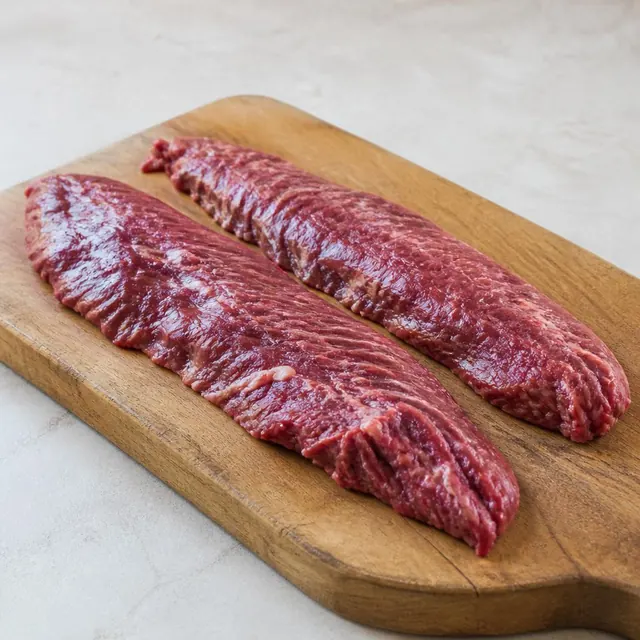
At a glance
- Cut
- Lumbar part of the diaphragm (its crura) near the kidneys, attached to the last rib and lumbar vertebrae.
- Production
- The tough membrane running down the middle is cut out before cooking.
- Substitutes
- Skirt steak from the diaphragm or flank steak.
Where on the animal
Beef
- Flank
An approximate diagram; butchers divide the carcass in slightly different ways from country to country.
The hanger steak is formed by the crura, or pillars, of the diaphragm – its lumbar part, which hangs in the middle of the carcass near the kidneys and attaches to the last rib and the lumbar vertebrae. Technically it counts as offal, but it is muscle meat; the right side is larger and stronger.
A tough membrane runs down the middle, which can be extremely chewy if left in; the meat has a coarse grain and bold flavour. The hanger does not belong to any of the main primals of the carcass.
In the US it is also called butcher's steak, in France onglet, in Italy lombatello, in Spain solomillo de pulmón, in Germany Nierenzapfen and in Bavaria and Austria Herzzapfen. The rest of the diaphragm is called Saumfleisch in German and gives skirt steak.