Meat cuts · International
Skirt steak
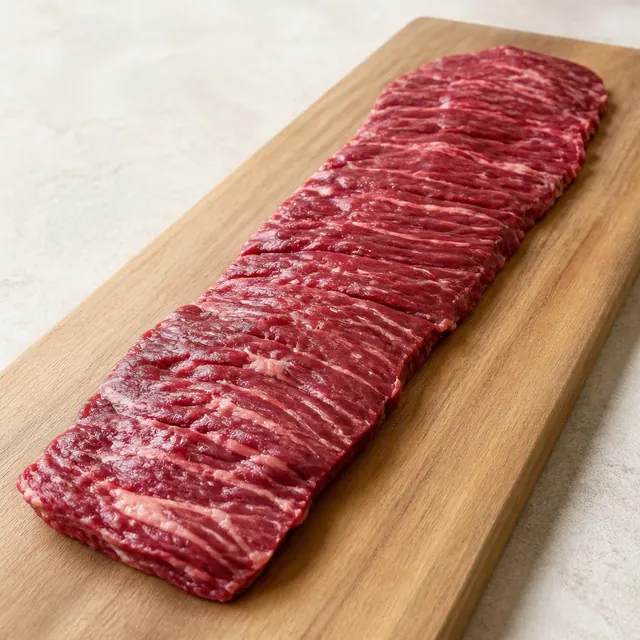
A long, flat cut from the diaphragm and abdominal wall with coarse grain – the meat for arrachera and fajitas.
At a glance
- Cut
- Diaphragm on the underside of the rib cage (outside skirt) and transversus abdominis (inside skirt), ribs 6–12.
- Production
- A long, flat boneless strip; the membrane is peeled off and the meat is sliced across the grain.
- Use
- Marinate, then grill or sear over high heat; traditionally arrachera and fajitas.
- Substitutes
- Flank steak or hanger steak.
Where on the animal
Beef
- Ribs
- Flank
An approximate diagram; butchers divide the carcass in slightly different ways from country to country.
Skirt steak is a long, flat cut from the diaphragm area on the underside of the rib cage; in American butchery it comes from the short plate around the 6th to 12th ribs. There are two kinds: the outside skirt is the diaphragm itself, while the inside skirt, according to some sources, is the transversus abdominis muscle; other sources assign both to the diaphragm.
The outside skirt tends to be more tender and is in greater demand, while the inside skirt is slightly chewier and milder in flavour; shops often sell both simply as skirt steak. The piece is covered by a tough membrane that is usually peeled off before cooking.
It has a coarse grain and bold flavour. It benefits from a long marinade or mechanical tenderising, followed by fierce grilling and slicing across the grain. It is the traditional meat for Mexican arrachera and fajitas; in German the diaphragm is called Saumfleisch, in Bavaria and Austria Kronfleisch.