Kitchen terms · International
Liaison
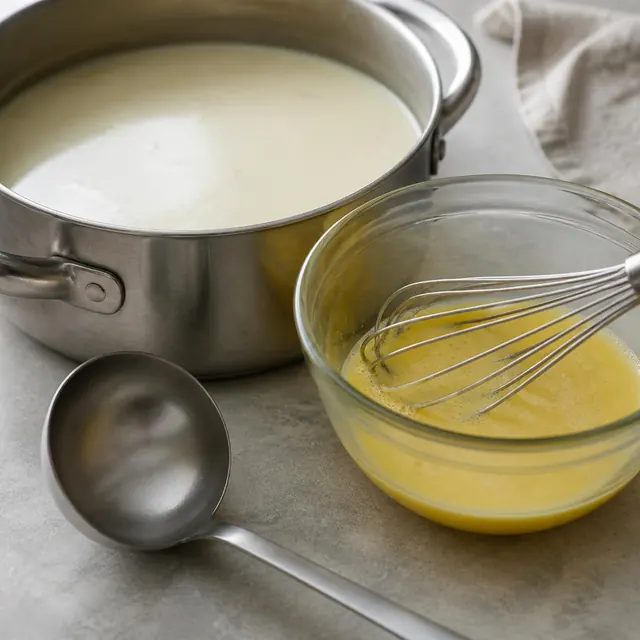
Thickening and enriching a soup or sauce with egg yolk, often mixed with cream.
At a glance
- Origin
- Ger. legieren (18th c.) from It. legare, Lat. ligare – to bind; Fr. liaison in cookery from 1393.
- Production
- Egg yolk, usually mixed with cream, is stirred into a hot but no longer boiling soup.
- Ratio
- McGee (warm egg-yolk sauces): yolk curdles at about 70–77 °C; Escoffier: 3 yolks and ⅕ pint (≈ 115 ml) cream per quart (≈ 1.1 l) of velouté soup.
- Use
- Velouté-type cream soups and white sauces.
- Substitutes
- Thickening with roux or starch; finishing with butter (monter au beurre).
The culinary sense of the Czech word corresponds to German legieren, which the DWDS explains as binding soups and sauces with egg yolk or flour, recorded in this sense from the 18th century; the word comes from Italian legare and Latin ligare, to bind. Czech dictionaries, the SSJČ and the Academic Dictionary of Foreign Words, list only the metallurgical sense of legovat, adding other metals to an alloy.
French liaison, a binding, is recorded in a culinary sense as early as 1393 in the Ménagier de Paris, and the Trésor de la langue française defines it as adding an ingredient that makes a preparation smooth and thick – roux, egg yolks, butter, cream or starch. For velouté soups Escoffier allows three yolks and one-fifth of a pint (≈ 115 ml) of cream per quart (≈ 1.1 l).
Temperature is decisive. McGee states that in warm egg-yolk sauces the yolk proteins coagulate into small curds at about 70–77 °C. A soup finished with yolk is therefore not allowed to boil again.
Techniques and tips
Related entries
Sources
- DWDS – Digitales Wörterbuch der deutschen Sprache: legieren
- Ústav pro jazyk český AV ČR: Internetová jazyková příručka (ASCS, SSJČ), heslo „legovat“
- CNRTL / ATILF: Trésor de la langue française informatisé, étymologie „liaison“
- CNRTL / ATILF: Trésor de la langue française informatisé, heslo „liaison“
- Auguste Escoffier: A Guide to Modern Cookery (London 1907), č. 27 Allemande sauce a kap. o polévkách velouté
- H. McGee: On Food and Cooking (2004), výňatek na CKBK: Heat Thickens and Curdles