Kitchen terms · International
Passing through a sieve
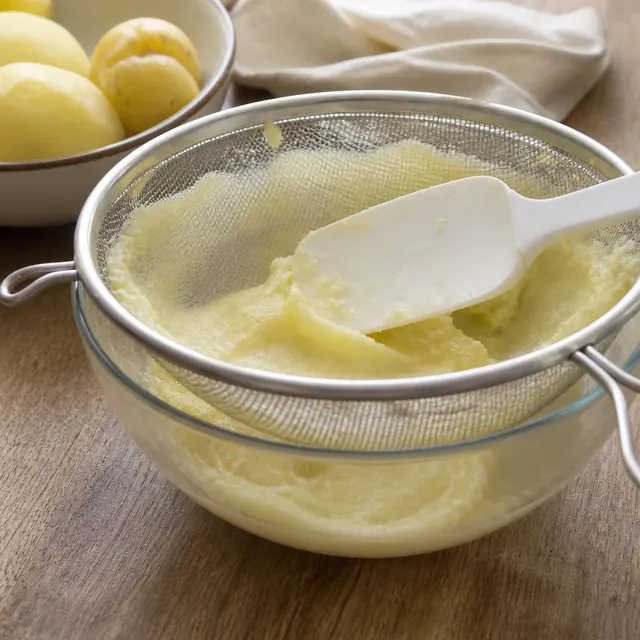
Pressing soft food through a sieve or food mill to make a smooth mash, purée, soup or sauce.
At a glance
- Origin
- Czech pasírovat from German passieren, itself from French (SSJČ).
- Production
- Soft food is pressed through a sieve, food mill or ricer, leaving fibres and lumps behind.
- Use
- Potato purée, fruit purées, cream soups and smooth sauces.
- Substitutes
- Straining separates liquid from solids; passing pushes the soft parts through a sieve.
The standard dictionary of literary Czech defines pasírovat in the culinary sense as pressing fruit or other food through a sieve or a mill, and notes that the word came from German and into German from French. German passieren, according to the DWDS, means besides going past also pressing something through a sieve. Unlike straining, the soft solids are not separated off but pushed through the sieve; only fibres, skins and lumps stay behind.
In Escoffier’s cookery book, rubbing through a fine sieve is a routine operation: sauces, purées and soups are passed this way to make them perfectly smooth. He makes mashed potatoes from boiled potatoes rubbed through a sieve, worked with 3 oz (≈ 85 g) of butter per lb (≈ 454 g) and finished with boiling milk.