Flours and grains · French cuisine
Buckwheat flour
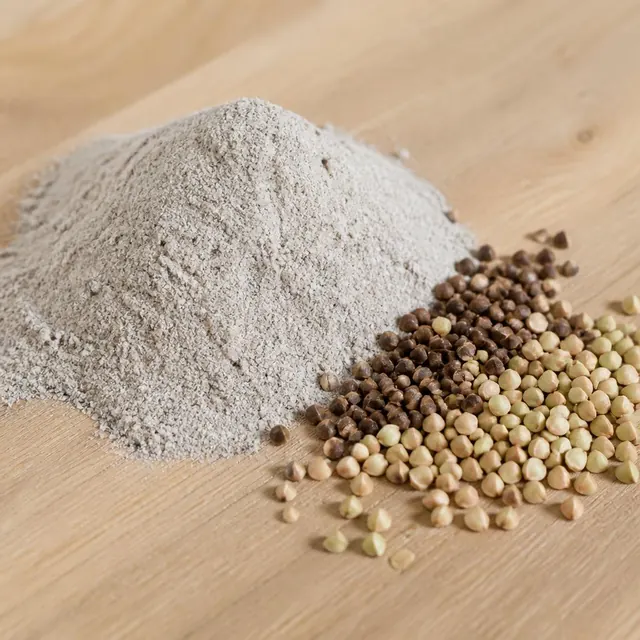
Flour from buckwheat, a pseudocereal of the knotweed family; naturally gluten-free, it is the flour of the Breton galette.
At a glance
- Origin
- Brittany (PGI Farine de blé noir de Bretagne – Gwinizh du Breizh) and Valtellina in Lombardy.
- Production
- Hulled or unhulled seeds are milled – in Brittany on rollers or millstones; the grain may be steamed or roasted first.
- Ratio
- For leavened bread it is blended with 50–65 % wheat flour.
- Use
- Galettes and crêpes, pizzoccheri, polenta taragna, an addition to bread.
Buckwheat (Fagopyrum esculentum) is not a cereal: rather than a grass like wheat or barley, it belongs to the knotweed family, together with rhubarb and sorrel. It is processed much like grain, which is why regulations class it as a pseudocereal. Before milling it may be steamed, kiln-dried or roasted, and it is ground both hulled and unhulled; in Austria buckwheat flour is also called Heidenmehl.
The flour contains no gluten, so it suits gluten-free cooking, but it cannot bind a dough by itself and is rarely used alone. For a well-risen bread, buckwheat and similar flours are blended with 50–65 % wheat flour. In Valtellina it goes into pizzoccheri, made from a mix of wheat and buckwheat flour, and into polenta taragna, where buckwheat is mixed with cornmeal.
Buckwheat (blé noir) has been grown in Brittany since the fourteenth century and copes well with poor soils. Farine de blé noir de Bretagne is a protected geographical indication (PGI) for historic Brittany; the flour has a pronounced aroma and taste and is used for galettes and crêpes.
Techniques and tips
Related entries
Sources
- INAO: Farine de blé noir de Bretagne – Gwinizh du Breizh (IG/02/00), fiche produit
- Altroconsumo: Grano saraceno, pizzoccheri e polenta taragna
- Österreichisches Lebensmittelbuch, IV. Auflage: Codexkapitel B 20 Mahl- und Schälprodukte (2022)
- Zanichelli / Franco Lucisano Editore: Aspetti tecnologici di panetteria e pasticceria, Servizi e tecniche di Enogastronomia – Cucina (2012)
- Ministerstvo zemědělství ČR: Vyhláška č. 18/2020 Sb. o požadavcích na mlýnské obilné výrobky, těstoviny, pekařské výrobky a cukrářské výrobky a těsta (2020)