Flours and grains · Italian cuisine
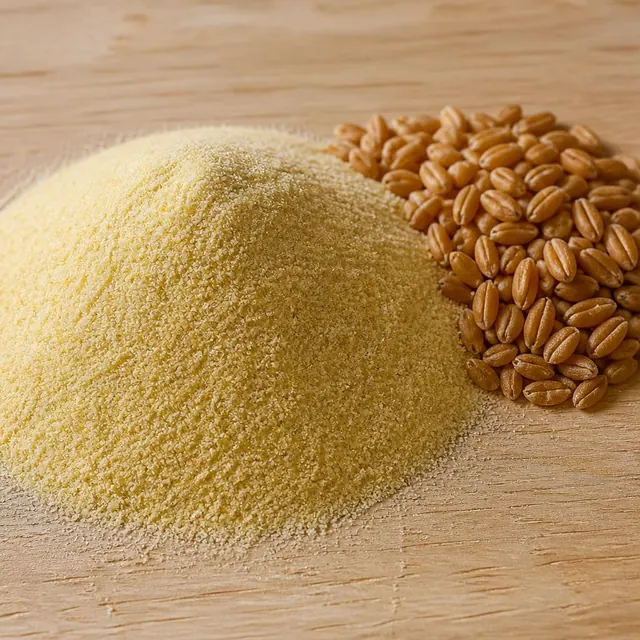
Semola rimacinata di grano duro
Re-milled durum wheat semolina that Italian law reserves for bread-making and retail sale; the basis of Altamura bread.
At a glance
- Origin
- Italy; defined in Presidential Decree 187/2001.
- Production
- Milling and sifting of durum wheat; the rimacinata version is milled a second time.
- Ratio
- Semola: ash ≤ 0.90 %, protein ≥ 10.50 % in dry matter, ≤ 25 % through a 0.180 mm sieve, ≤ 3 % common wheat. Pane di Altamura: per 100 kg semola, 20 kg sourdough, 2 kg sea salt and about 60 l water.
- Use
- Rimacinata: bread, above all pane di Altamura. Ordinary semola: dried pasta.
Under Italy's Presidential Decree 187/2001, semola is a granular product with sharp-edged particles obtained by milling and sifting durum wheat (grano duro, Triticum durum). It may contain no more than 0.90 % ash and must have at least 10.5 % protein in dry matter, and no more than 25 % may pass a 0.180 mm sieve. Semolato is the stream obtained after the semola has been extracted. Re-milled semola and semolato (rimacinati) are permitted only for bread-making and for sale to consumers.
Ordinary semola and water make Italian dried pasta; durum wheat suits it because of the particular structure of its proteins. The Czech decree uses semolina only for durum krupice, while krupice in general is a coarser product from the first stage of milling any cereal – so the two words are not interchangeable.
Semola rimacinata is the basis of pane di Altamura PDO: at least 80 % must come from the durum varieties appulo, arcangelo, duilio and simeto grown in the defined Murgia area, and the dough is raised with sourdough.
Techniques and tips
Related entries
Sources
- Presidente della Repubblica: DPR 9 febbraio 2001, n. 187 – Regolamento per la revisione della normativa sulla produzione e commercializzazione di sfarinati e paste alimentari (2001)
- Evropská komise, rejstřík eAmbrosia: Pane di Altamura DOP – dokument k disciplinare di produzione
- Ministerstvo zemědělství ČR: Vyhláška č. 18/2020 Sb. o požadavcích na mlýnské obilné výrobky, těstoviny, pekařské výrobky a cukrářské výrobky a těsta (2020)
- Österreichisches Lebensmittelbuch, IV. Auflage: Codexkapitel B 20 Mahl- und Schälprodukte (2022)