Kitchen terms · French cuisine
Blanching
Briefly scalding an ingredient in boiling water or steam, usually followed by quick cooling.
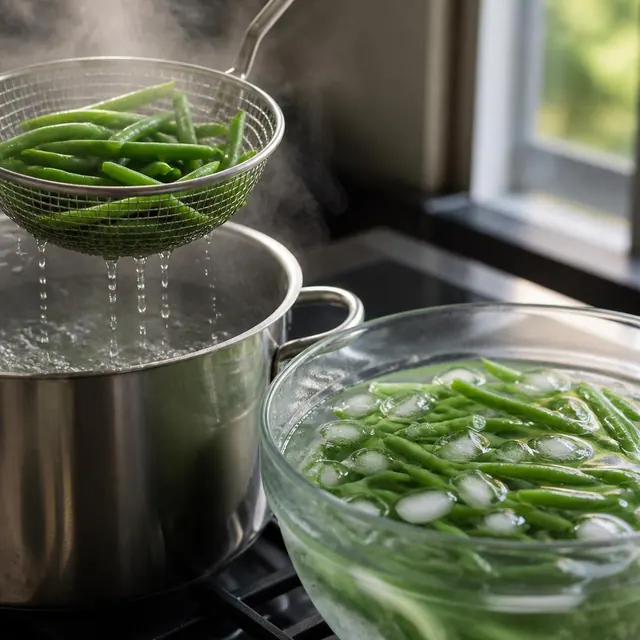
At a glance
- Origin
- French blanchir, to whiten.
- Production
- A short scald in boiling water or steam followed by rapid cooling in cold water.
- Ratio
- NCHFP: about 1 gallon of water per pound of vegetables (roughly 8 l per kg), water back to the boil within 1 minute, cooling in water at no more than 60 °F (about 16 °C) or in ice water.
- Use
- Preparing vegetables for freezing, parboiling meat and vegetables, taming harsh flavours.
- Substitutes
- Escoffier calls cooking green vegetables in boiling salted water “à l’anglaise”.
The word comes from French blanchir, to whiten; according to the Trésor de la langue française, its culinary sense is to scald vegetables in boiling water to remove their harshness. Escoffier’s 1907 guide calls the term expressly unsuitable, because it covers three different operations: blanching meat, parboiling vegetables, and a process that is really cooking. Cooking green vegetables in boiling salted water should, in his view, be called “à l’anglaise”.
Meat such as calf’s head or sweetbread Escoffier puts into cold water, brings gradually to the boil and then cools in fresh water. The US National Center for Home Food Preservation describes blanching vegetables before freezing as a short scalding in boiling water or steam that stops enzyme actions which would otherwise spoil flavour, colour and texture; it warns that under-blanching is worse than not blanching at all.
Recipes
Techniques and tips
Related entries
Sources
- CNRTL: Trésor de la langue française informatisé – blanchir
- A. Escoffier: A Guide to Modern Cookery (London 1907), č. 273 Blanchings; Project Gutenberg eBook #71395
- National Center for Home Food Preservation (University of Georgia): Blanching Vegetables
- ÚJČ AV ČR: Internetová jazyková příručka – blanšírovat