Flours and grains · International
Glutinous rice
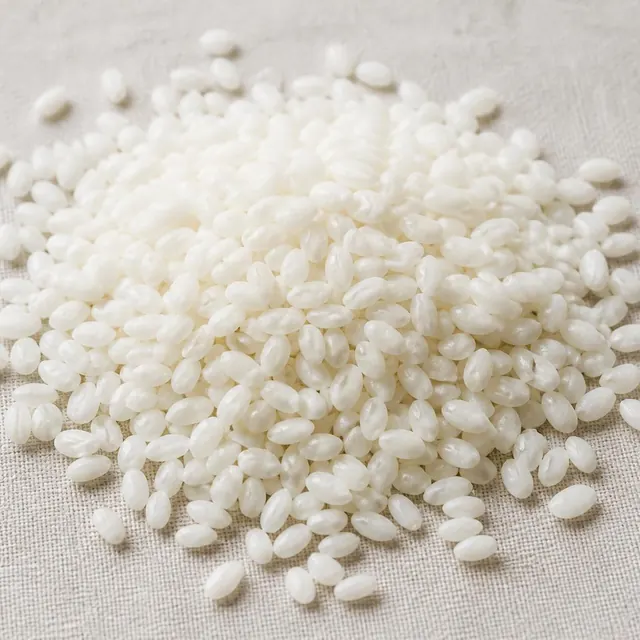
Rice with an opaque white grain and almost no amylose that clumps together when steamed; despite the name it contains no gluten.
At a glance
- Origin
- East and Southeast Asia; so-called waxy rice with an endosperm almost free of amylose.
- Production
- Rinsed, soaked and steamed.
- Ratio
- Amylose 0–2 %, the rest of the starch is amylopectin.
- Use
- Sekihan, rice cakes (some with coconut milk), rice wines.
Glutinous or waxy rice is rice whose starch contains only 0–2 % amylose and consists almost entirely of amylopectin. Its endosperm is therefore opaque rather than translucent like that of ordinary rice, and the cooked grains stick together. It contains no gluten, however: rice is not among the gluten-containing cereals listed in the EU food information regulation.
In processing it is rinsed, soaked and steamed; steamed glutinous rice is also the base for rice wines and cakes. In Japan it is steamed with adzuki beans as sekihan and in the Philippines it is made into cakes such as suman or tikoy.
Glutinous rice changes less with ageing than ordinary rice.
Recipes
Techniques and tips
Related entries
Sources
- FAO/IRRI, B. O. Juliano: Rice in human nutrition, kap. 3 Grain structure, composition and consumers' criteria for quality (1993)
- FAO/IRRI, B. O. Juliano: Rice in human nutrition, kap. 3 Grain quality (1993)
- FAO/IRRI, B. O. Juliano: Rice in human nutrition, kap. 6 Major processed rice products (1993)
- FAO/IRRI, B. O. Juliano: Rice in human nutrition, kap. 6 Major processed rice products, pokračování (1993)
- Evropská unie: Nařízení (EU) č. 1169/2011, příloha II – látky způsobující alergie nebo nesnášenlivost (2011)
- JA Zen-Noh: Japanese rice – varieties and characteristics