Kitchen terms · International
Larding and barding
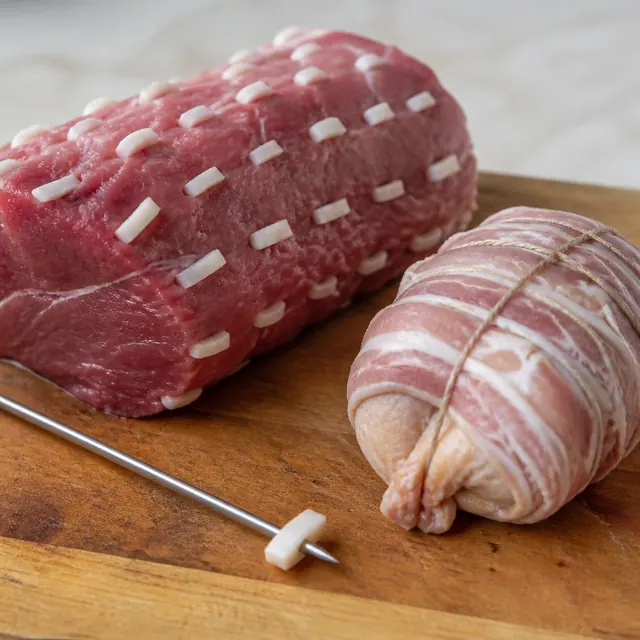
Two ways of adding fat to lean meat: threading it with strips of bacon fat and wrapping it in slices of bacon.
At a glance
- Origin
- Czech špikovat from Ger. spicken (15th c., from Speck); Fr. larder (1155) and barder (1680).
- Production
- Larding threads meat with strips of fat; barding wraps it in slices of bacon.
- Ratio
- Escoffier: strips about ½ inch (≈ 1.3 cm) thick, roughly 3 oz (≈ 85 g) bacon fat per 1 lb (≈ 454 g) meat.
- Use
- Lean beef and mutton for braising, game, roast poultry.
- Substitutes
- Instead of bacon, Escoffier sometimes covered roasts with veal or beef fat.
According to the Academic Dictionary of Foreign Words, špikovat means to thread meat with bacon; the SSJČ gives its origin as German. German spicken, derived from Speck, is recorded from the 15th century, and the DWDS explains it as threading lean meat with strips of bacon fat before roasting to make it juicier; the tool is the larding needle, recorded from the 16th century. French calls this larder, attested as early as 1155.
Barding means wrapping meat in thin slices of bacon. The DWDS defines German bardieren as covering poultry with bacon slices; French barder in its culinary sense is recorded from 1680.
Escoffier larded lean braising joints such as beef rump or leg of mutton, which would otherwise dry out in long cooking. Strips of fat about half an inch (≈ 1.3 cm) thick and as long as the meat were seasoned, marinated in brandy and inserted evenly, about 3 oz (≈ 85 g) per lb (≈ 454 g) of meat. He covered the breasts of roast poultry and game with bacon to shield them from the heat and keep them moist while the legs cooked.
Recipes
Menus
Related entries
Sources
- Ústav pro jazyk český AV ČR: Internetová jazyková příručka (ASCS, SSČ, SSJČ), heslo „špikovat“
- DWDS – Digitales Wörterbuch der deutschen Sprache: spicken
- DWDS – Digitales Wörterbuch der deutschen Sprache: bardieren
- CNRTL / ATILF: Trésor de la langue française informatisé, étymologie „larder“
- CNRTL / ATILF: Trésor de la langue française informatisé, étymologie „barder“
- Auguste Escoffier: A Guide to Modern Cookery (London 1907), č. 247 Ordinary braisings a č. 252 Larding bacon for roasts