Pasta shapes · Italian cuisine
Bucatini
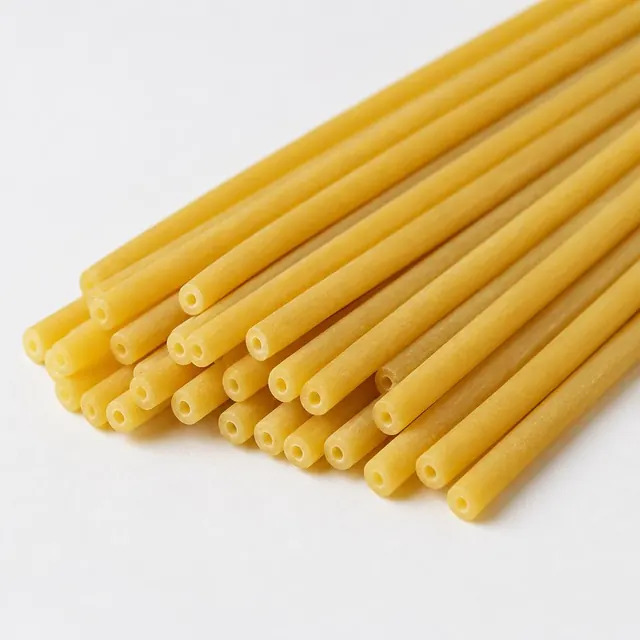
Thick spaghetti-like strands with a fine hole running through – the classic for amatriciana.
At a glance
- Origin
- Italy, an industrial shape; known in Sicily under local names.
- Dough
- Durum wheat semolina and water.
- Production
- Extruded through a die with a pin forming the hole, then dried.
- Pairs with
- All’amatriciana, gricia, cacio e pepe.
- Cooking time
- Dried 7–9 min, depending on the maker.
Bucatini are long strands about 3 mm across and roughly 26 cm long, pierced by a fine hole along their whole length; the wall is about 1 mm thick. The name refers to a hole or piercing; they are also called perciatelli, and Sicily has its own local names for them.
This is an industrial shape of durum semolina and water, extruded through a die and dried. The central hole lets water in, so bucatini cook in about the same time as spaghetti despite being thicker. That is what sets them apart from large fresh hollow strands such as bigoli or pici, which have to be made fresh.
They are traditionally served all’amatriciana, and also with gricia or cacio e pepe; thicker kinds are broken into soups or baked.
Recipes
Techniques and tips
Related entries
Sources
- Caz Hildebrand, Jacob Kenedy: The Geometry of Pasta (2010), heslo Bucatini
- Oretta Zanini De Vita: Encyclopedia of Pasta (2009), heslo Bucatini
- Alan Davidson: The Oxford Companion to Food, heslo Pasta shapes
- Divella: 6 Bucatini, údaj doby vaření
- Pasta Garofalo: N° 14 Bucatini, údaj doby vaření
- Granoro: Bucatini Dedicato n. 11, údaj doby vaření