Kitchen terms · Czech cuisine
Dusting with flour
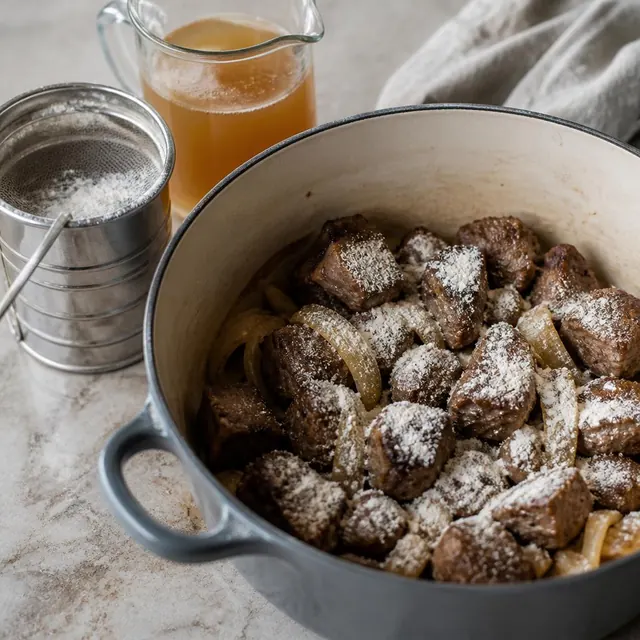
Sprinkling browned meat, vegetables or a sauce with a little flour, which thickens the juices once liquid is added and simmered.
At a glance
- Origin
- Czech zaprášit in its culinary sense (SSJČ); Fr. singer (TLFi).
- Production
- Flour is sprinkled straight onto sautéed meat or vegetables, then liquid is added.
- Use
- Goulash, ragouts, braised meat and poultry, sauces.
- Substitutes
- Roux: the flour is first cooked separately in fat.
The standard dictionary of literary Czech lists for zaprášit the culinary sense of dusting meat or a sauce with flour, that is sprinkling it with something powdery. The flour is not cooked separately as for a roux but sprinkled straight onto the meat or vegetables in the pot.
French cookery has the verb singer for the same step. The Trésor de la langue française explains it as sprinkling a preparation with a few spoonfuls of flour that is then moistened and, on heating, thickens the sauce; its example cites pieces of poultry sautéed without colouring, dusted and moistened with white wine and veal stock. Escoffier likewise sprinkles onions stewed in butter without colouring with half an ounce (≈ 14 g) of flour and moistens them with boiling milk.